 icking five out of 21 was hard enough!)
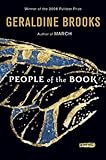
If I was required to pick an absolute favorite from the year, this one might be it. People of the Book by Geraldine Brooks became a new favorite of mine immediately, and made Brooks an author whose books I will now keep a special eye out for. Describing the plotline of the book really does not explain how beautifully the story is told. It is the story of a book, a manuscript that has been rediscovered, and is now being researched and restored. As the one in charge of restoring the book, Hanna, discovers more about its history, the reader gets a glimpse of that piece of the book's life. Like I said, that description does nothing to describe the depth of feeling that comes through in each of these stories. I love books, and book history, but I think that this book would appeal to anyone who loves to read well-researched historical fiction.
 I Am the Messenger was the second book that I read by Marcus Zusak (the first being The Book Thief), and it placed him solidly on my list of favorite authors. The story follows Ed Kennedy, an underage cabdriver who doesn't have much of a plan for his life, a fact which seldom bothers him. Then he stops a bank robbery, and his life becomes a kind of mystery. He begins receiving playing cards, aces, which have cryptic instructions on them that he struggles to decipher and follow. His life changes dramatically as a result of these strange messages, in a way that is uplifting but not pedantic. Ed is a fantastic character, one who you love to root for, who is deep and complicated and not perfect, but who you would love to have as a friend. This book is often catalogued as a teen book, but it would be enjoyed by teens and adults of any age.
 Another teen book, actually a series, that can easily be appreciated by adults (I've actually recommended it to several friends) is the Eugenides series by Megan Whalen Turner. This series consists of The Thief, The Queen of Attolia, and The King of Attolia. I wish I knew whether or not there were going to be more books in this series, because the character of Eugenides is terrific, and I can't wait to find out more about him. The best part about this series is how crafty and surprising Eugenides is. The second best part is the fact that none of the characters are formulaic - they are all surprising and individual, never doing what you would predict. This is an excellent series for middle schoolers on up to adults, and would be enjoyed even by those who don't tend to read fantasy.
For some reason, The Curious Incident of the Dog in the Night Time, by Mark Haddon, reminds me of I Am the Messenger. I think that part of it has to do with the way that they both hook you instantly. They are both quick reads, and once you begin them it is almost impossible to put them down. Nothing in the plot is similar to I Am the Messenger, however. The Curious Incident is about a 15-year-old autistic boy who sets out to discover the identity of the murderer of his neighbor's dog. It is told in first-person point of view, so we know every thought that goes through Christopher's head. The fact that he is a high-functioning autistic makes this a fascinating story to read. He is logical to the point where he can't understand metaphors or cliches, so he just responds as if he did not hear them. His interactions with others make this story humorous, but it is also dark in many ways. Enough babbling, I just loved this book.
 My final recommendation of favorite reads of the year was Half of A Yellow Sun, by Chimamanda Ngozi Adichie. This was a heartbreaking book, about the seccession of Biafra from Nigeria in the late 1960's. Biafra's symbol is the rising sun, a theme that is carried throughout the book. The war ends badly for the Biafrans, as the validity of the country was never recognized by most of the world. The story is told from the point of view of three different people, whose lives interact in various different ways. It is beautifully told, and even though the reader knows the outcome of the war, the book itself is filled with hope. It is a long book, and a difficult read, but well worth the time.
And there you have it. My five top favorites of 2008. If you are interested in seeing what the other 16 titles were that I labeled as recommended, just click on the link in this post.
Happy New Year's Eve!


 Posts
Posts

