The Syringa Tree takes place in South Africa, with most of the action happening during the 1960's. As with much of the fiction that I've read recently, I feel that if I knew more about the background of this time and place in history, I would have gotten more out of the book. But learning about this time period from a young girl provided a very interesting picture. The main character is little Elizabeth Grace, who is six when the story begins. She is white, but of mixed heritage (Jewish, English Catholic, and Afrikaans), and she first learns of prejudice from her next door neighbor, the pure-Afrikaans (and proud of it) Loeska. Elizabeth realizes that she and her family are privileged, yet they are still treated with disdain by their Afrikaans neighbors. Salamina, Elizabeth's nanny, is Xhosa, and as things get worse politically in Johannesburg, the Grace family must protect Salamina. She is pregnant, and they know that she will not be allowed to keep her child with her in Johannesburg. All blacks must have permits showing they are allowed to work in Johannesburg, and a child would not have such a thing.
The story moves forward rather jerkily through time. The story finishes when Elizabeth is an adult, but most of the story does take place when she is between the ages of six and ten. Her relationship with Salamina and her daughter Moliseng is the central piece of the story, and the defining factor of her existance. She blames herself for the difficulties that arise as things get worse in Johannesburg, even though she has no control over the situation. The resolution that comes when she is an adult is the most moving part of the book. I felt that the rest of the book was just leading up to it. It is lovely and satisfying, and slightly heart-breaking. This book is worth reading just for that, and for someone who knows more about that time in South Africa, the book will have even more meaning and depth.
Thursday, September 18, 2008


Wednesday, September 17, 2008
A Game of Thrones by George RR Martin
Picking up this book totally threw off my normal reading pattern. I grabbed it at a friend's house when I needed something to read, meaning it got ahead of the stack of books I should be reading. I have wanted to check out this series, A Song of Ice and Fire, for quite some time, but I never found the time to add it to the stack of books I always have out from the library. But now I've read the first one, and my friend has loaned me the rest. Not that I'll be reading them anytime soon, but I will get to them eventually.
A Game of Thrones is the story of the land of the Seven Kingdoms, which are not actually seven separate kingdoms, but one, under the rule of King Robert. Robert gained the throne 15 years previous to the beginning of the book when he overthrew the tyrant before him. He was supported in that war by his closest friend, Eddard Stark, the man who is Lord of Winterfell, and the over all of the northern parts of the Seven Kingdoms. The Starks are an old family who have been in the north for centuries. Most of the story is told from one of their points of view. (Each chapter has a different narrator, though the story is told in third person.) The book begins with the death of the Hand of the King, and Robert comes to Winterfell to offer that position to Stark. Stark does not want it, but the King's wife and her family are scheming for power, and he believes that the best way to keep his family safe is to become the new King's Hand.
The story is incredibly complicated, in a way only an epic fantasy can be, with ancient families and grudges, intrigue, murder, bastard sons, and kings-in-exile. But the characters are wonderful, even the ones you hate, and hearing the story told from so many different angles is interesting, but frustrating at the same time. I honestly almost had to give up on the book a few times, because I don't deal well with terrible things happening to characters that I like, unless the author has a very good reason for it. Martin convinced me to keep reading, even if I didn't figure out all of his reasons for what his characters go through. I am definitely looking forward to the next book, whenever I get around to reading it.
A Game of Thrones is the story of the land of the Seven Kingdoms, which are not actually seven separate kingdoms, but one, under the rule of King Robert. Robert gained the throne 15 years previous to the beginning of the book when he overthrew the tyrant before him. He was supported in that war by his closest friend, Eddard Stark, the man who is Lord of Winterfell, and the over all of the northern parts of the Seven Kingdoms. The Starks are an old family who have been in the north for centuries. Most of the story is told from one of their points of view. (Each chapter has a different narrator, though the story is told in third person.) The book begins with the death of the Hand of the King, and Robert comes to Winterfell to offer that position to Stark. Stark does not want it, but the King's wife and her family are scheming for power, and he believes that the best way to keep his family safe is to become the new King's Hand.
The story is incredibly complicated, in a way only an epic fantasy can be, with ancient families and grudges, intrigue, murder, bastard sons, and kings-in-exile. But the characters are wonderful, even the ones you hate, and hearing the story told from so many different angles is interesting, but frustrating at the same time. I honestly almost had to give up on the book a few times, because I don't deal well with terrible things happening to characters that I like, unless the author has a very good reason for it. Martin convinced me to keep reading, even if I didn't figure out all of his reasons for what his characters go through. I am definitely looking forward to the next book, whenever I get around to reading it.
Tuesday, September 16, 2008
The Invention of Hugo Cabret by Brian Selznick
 A beautiful, beautiful book. Hugely thick, which might make some children worry, but most of those pages are pictures. It is not, however, a graphic novel. The pictures are separate from the text, but they tell the story just as much. They do not describe what the prose describes, they are a replacement for words. So Selznick takes us back and forth in between words and pictures to tell his story.
The story of Hugo Cabret is lovely, a story of hope lost and found, of discovering who you are and who you are meant to be. Hugo is a teenage boy who lives in a Paris train station. He takes care of the clocks, keeping up the pretense that it is his vanished uncle doing so. He dreams of magic, and of the automaton that he saved from the fire that killed his father. Various problems arise as he attempts to restore the automaton, and he finds himself discovered, and his sketchbook stolen, by the old man who runs a toy shop in the train station. The excitement builds as Hugo gets closer to finishing the automaton, which he believes carries within it a message from his father; Hugo is also becoming more and more likely to be discovered. Who is the old man who runs the toy shop, and why is he so interested in the automaton. Hugo and the man's foster child Isabelle join together to find out, and to bring dreams and magic back to his and their lives.
This is a wonderful book to read together with someone, child and adult alike. The pictures make the story more mysterious and exciting, and the real life story behind to book is a great lesson in the history of film. I really can't recommend this book enough.
Monday, September 15, 2008
Skulduggery Pleasant by Derek Landy
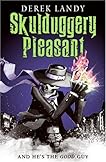 I had seen this book around many times before I finally decided to go ahead and read it, so in my break between classes I picked it up. The story follows 12-year-old Stephanie Edgely, and precocious girl whose favorite uncle has just been murdered. At the wake she runs into a strange man named Skulduggery Pleasant. That man is also at the reading of the will, where Stephanie finds out that her uncle has left most of his assets to her, despite having two living brothers. While exploring her uncle's home, Stephanie is attacked by a strange man, and then saved by Skulduggery Pleasant, who, unsurprisingly, turns out to be a skeleton. She insists that Skulduggery bring her along in his investigation into her uncle's murder. In this way Stephanie discovers a world of magic that she never knew existed. She and Skulduggery partner up against the bad guys to save the world, which they do, for now.
The book definitely sets itself up for sequels to follow. This is just the beginning of the intrepid partnership, after all. The characters are very entertaining, and the relationship between Stephanie and Skulduggery is consistantly amusing. Their banter does not get old, though it can get a bit silly. The story keeps moving at a rapid pace, and the excitement does not slow down very often. This book would be very engaging to young teens and middle schoolers, who would not only appreciate the jokes, but would also feel a kinship with Stephanie, and her desire to find a world outside of that she has known.
Saturday, September 13, 2008
Your Money or Your Life by Joe Dominguez and Vicki Robin
 I first heard about this book from another book called Radical Simplicity. They used some of the ideas that Your Money or Your Life advocates, but I decided to just get the actual book and go all the way through it. The basic premise of Your Money or Your Life is that money is not just money, it is your life's energy. It is equal to the life energy you spent to earn it at your job. One of the first steps in the book (well, technically, I think it might be the third step) is to discover what your "real wage" is. You do this by first adding up all of the money that you spend specifically for work: this includes commuting expenses, lunch, work-specific clothing, and even things that you do when you get off of work to wind-down. The idea is to imagine what you would no longer be spending if you didn't have to go to work every day. So, you get that totaled. Then you figure out how much time you are spending at work, and you also include commute time and leisure time, the same way you did for the money exercise. Using these figures, you figure out how much you really take home per hour of "work", work equaling all of the time spent. It's a very revealing exercise.
The rest of the nine steps involve tracking your expenses in one way or another. The authors invite you to analyze each purchase you make in terms of your values. Are your purchases in line with your values? If not, why not? The book is not about creating budgets, or cutting back on spending. It is about learning to value money for what it is, and learning to truly appreciate what we have. Spending less and saving more should simply come naturally as a result, at least according to the authors.
I find this idea of money very powerful, and I intend to actually begin the program, now that I've read the book in its entirety. The book can be a bit much, there are a ton of personal anecdotes that I found not very helpful, and the original edition came out in the early eighties, so it is a bit out of date. The first couple of steps are supposed to get you off and running, but I simply plan on not actually doing them. I also don't plan on following the author's investment advice. But all-in-all, I think this book is tremendous, and could help anyone get real with their finances. In our all-consuming, disturbingly in debt society, views like that in this book are refreshing.
Wednesday, September 10, 2008
The Spiderwick Chronicles by Tony DiTerlizzi and Holly Black
I picked up the first Spiderwick Chronicles book, mainly because I was curious because there was a movie coming out. Each of the books can be read in a sitting, depending on how fast you read. The basic plotline follows the Grace twins, Jared and Simon, with Jared being the main character. The Grace family, Mom, the twins, and older sister Mallory, have moved into their Great-Aunt Lucinda's house, after the parent's divorce. The house is creepy, and from the first Jared discovers that it holds strange secrets. He finds a hidden way into his Arthur Spiderwick's study, and there finds the field guide. Thus begins his adventure into the world of faerie, which is really all around us, if you know how to see it. The twins and their sister must save the book, their family, and the good guys of faerie from the evil ogre Mulgarath, who wants to get his hands on the field guide in order to destroy all the other creatures.
I wasn't expecting much, for some reason, but I was pleasantly surprised by how entertaining the books were. I enjoyed the characters, especially Mallory. She's a typical young heroine - a fighter, smart, unafraid - but she argues like crazy with her obnoxious little brothers. How true to life! I loved it. I also liked the way they didn't hide Jared's anger, and made it clear that he struggled with how to deal with it. His parents divorce is not simply glossed over. These are very enjoyable books, great for any kid ready to read this level of chapter book.
**And a side note: I saw the movie last night. Please, please remind me never to expect anything that comes out of Hollywood to have anything resembling what was actually in the book that the movie is made from. I am always disappointed. Every time I think, "Well, maybe if I hadn't read the book, I would have enjoyed that." Of course I exaggerate. The movie resembles the book. But the changes they make are so typical of Hollywood, so obviously just to sell, it sickens me. And I didn't even feel particularly invested in this particular story. Oh well, like I said, remind me next time.
I wasn't expecting much, for some reason, but I was pleasantly surprised by how entertaining the books were. I enjoyed the characters, especially Mallory. She's a typical young heroine - a fighter, smart, unafraid - but she argues like crazy with her obnoxious little brothers. How true to life! I loved it. I also liked the way they didn't hide Jared's anger, and made it clear that he struggled with how to deal with it. His parents divorce is not simply glossed over. These are very enjoyable books, great for any kid ready to read this level of chapter book.
**And a side note: I saw the movie last night. Please, please remind me never to expect anything that comes out of Hollywood to have anything resembling what was actually in the book that the movie is made from. I am always disappointed. Every time I think, "Well, maybe if I hadn't read the book, I would have enjoyed that." Of course I exaggerate. The movie resembles the book. But the changes they make are so typical of Hollywood, so obviously just to sell, it sickens me. And I didn't even feel particularly invested in this particular story. Oh well, like I said, remind me next time.
Tuesday, September 9, 2008
The Book of Pellinor series by Alison Croggon
This rather lengthy couple of books reminded me of the first books that I read by Tad Williams, the Memory, Sorrow, and Thorn series. The Book of Pellinor series is made up of four books, the last of which is not yet out. The first three books are The Naming, The Riddle, and The Crow. The first two books are told from the point of view of Maerad, the third is told from the point of view of her brother, Ham.
Maerad is a young girl who is a slave, although she remembers when she and her mother fled their home, and were sold to the man she now works for. Her mother died soon after they were sold. When she sees through a bard's invisibility spell, the bard Cadvan knows he must take her with him. They flee together, although Maerad knows nothing of the world outside. Cadvan helps her to remember her mother, and they discover that her mother was the first bard of Pellinor, which was destroyed a decade previously. Maerad joins Cadvan as he travels the land, trying to discover if evil has returned to the lands to corrupt the light. During their travels they rescue Ham, an discover that he is Maerad's brother, thought to be dead with her father in the sack of Pellinor.
The Riddle begins after Maerad and Cadvan split from Ham and his guardian, Saliman. Ham is to go south with Saliman while Maerad and Cadvan seek out the treesong. They are following the riddles of prophecy, a prophecy that says Maerad is the chosen one. She doesn't understand what it is she is meant to do, but she does her best to control her growing powers and help save the kingdom. The Crow takes place over the same period of time as The Riddle, only following Ham's adventure's and trials in the south, as he learns what his part is in the fulfillment of the prophecy.
This series is very enjoyable, great for any teens (or adults) who enjoy reading truly epic fantasy. The writing is not difficult to read, and the style is very fluid and engrossing. The characters do not always make the right choices, and their failures are hard to read, but necessary. They grow and learn from their mistakes, and create a bond between reader and character that make the books hard to put down. I am looking forward to reading the final book of the quartet.
Maerad is a young girl who is a slave, although she remembers when she and her mother fled their home, and were sold to the man she now works for. Her mother died soon after they were sold. When she sees through a bard's invisibility spell, the bard Cadvan knows he must take her with him. They flee together, although Maerad knows nothing of the world outside. Cadvan helps her to remember her mother, and they discover that her mother was the first bard of Pellinor, which was destroyed a decade previously. Maerad joins Cadvan as he travels the land, trying to discover if evil has returned to the lands to corrupt the light. During their travels they rescue Ham, an discover that he is Maerad's brother, thought to be dead with her father in the sack of Pellinor.
The Riddle begins after Maerad and Cadvan split from Ham and his guardian, Saliman. Ham is to go south with Saliman while Maerad and Cadvan seek out the treesong. They are following the riddles of prophecy, a prophecy that says Maerad is the chosen one. She doesn't understand what it is she is meant to do, but she does her best to control her growing powers and help save the kingdom. The Crow takes place over the same period of time as The Riddle, only following Ham's adventure's and trials in the south, as he learns what his part is in the fulfillment of the prophecy.
This series is very enjoyable, great for any teens (or adults) who enjoy reading truly epic fantasy. The writing is not difficult to read, and the style is very fluid and engrossing. The characters do not always make the right choices, and their failures are hard to read, but necessary. They grow and learn from their mistakes, and create a bond between reader and character that make the books hard to put down. I am looking forward to reading the final book of the quartet.
Monday, September 8, 2008
Kushiel's Mercy by Jacqueline Carey
I really shouldn't even be bothering to review this book, as I am in no way objective about this series, but oh well. I love the Kushiel's legacy series by Carey. I spent my birthday reading this book, and I consider that a day very well spent. The world of Terre D'Ange is just so easy to immerse yourself in, and the story moves at a pace that drives you to keep reading no matter what. This is the sixth book that takes place in this alternate Earth that Carey has created. The main character, Imriel, has come clean about his love for the Princess Sidonie, but in order to prove that his love is true, he must bring his traitorous mother to justice. He is foiled by a plot to rip the country apart when magic makes all of those in the city forget about his betrothal and promise. They now believe that Sidonie was betrothed to the general of Carthage, whom she marries, causing Terre D'Ange to break one of its most important political alliances. Civil war threatens, as those who were not in the city when the magic was done can not understand why the Queen is making the decisions the way she is. And only Imriel's mother can help him undo the curse and bring Sidonie back.
Describing the plot of the book is entertaining, as it sounds a little bit ridiculous, but I suppose it is a fantasy. Terre D'Ange is a country ruled by the precept, given to them by their God Elua, "Love as thou wilt". All love is considered sacred, and by extension, so is every sexual encounter. Courtesans are held in very high regard as a result. A warning to any who would read these, especially the first three books in the series: the sex is described fairly graphically, and there are instances of sado-masichism as well, that Carey is not afraid to delve into. I wish that I was able to recommend these books more freely, because they are tremendously beautiful and engrossing, but the erotica aspect makes that difficult. But if you can enjoy that aspect of it, or at least get through it, then this is definitely worth the read.
Describing the plot of the book is entertaining, as it sounds a little bit ridiculous, but I suppose it is a fantasy. Terre D'Ange is a country ruled by the precept, given to them by their God Elua, "Love as thou wilt". All love is considered sacred, and by extension, so is every sexual encounter. Courtesans are held in very high regard as a result. A warning to any who would read these, especially the first three books in the series: the sex is described fairly graphically, and there are instances of sado-masichism as well, that Carey is not afraid to delve into. I wish that I was able to recommend these books more freely, because they are tremendously beautiful and engrossing, but the erotica aspect makes that difficult. But if you can enjoy that aspect of it, or at least get through it, then this is definitely worth the read.
Tuesday, September 2, 2008
Lock and Key by Sarah Dessen
 This is the first book I have read by Sarah Dessen, and since reading it, I have been able to recommend her books to several teens. I suggested her before, simply because her books are popular, but I never really had any basis for my suggestions. Now I have read one, and if the others are as good as Lock and Key, then recommending her books is always a good idea.
I found the premise of the book to be a little bit too Cinderella-ish, but Dessen does a good job of bringing the story back to reality. The main character is Ruby, a seventeen-year-old who has been living on her own for a few months, trying to make it to eighteen without anyone realizing that her mom is gone. She gets caught, however, and ends up being sent to live with the sister that left her family ten years earlier, who Ruby has not heard from since. Cora now lives in a large house with a huge yard in a gated community, with a husband who tries very hard to make Ruby feel at home. Cora is a little bit more hesitant, as if she is no longer sure where she and Ruby stand in their relationship; Ruby doesn't know what to expect either. She begins attending the local prep school, and meets the boy next door, who seems too nice to be real. But this book is about secrets, and about how we lie to ourselves and others to get through life. So nothing is as simple as it seems.
The connections that Dessen makes between Ruby's previous life and the one she now finds herself in are beautiful and moving. She does a wonderful job of moving between the past and present, with Ruby narrating. The story and the relationships are entirely believable, though at first I didn't believe that that was possible. Each of the characters is unique and interesting, and illuminates the story in their own way, even if they seemed like a minor character at the outset. I found the book inexplicably moving, and would recommend it to any high school teen who likes to read about real people.
Monday, September 1, 2008
Mouse Guard: Fall, 1152 by David Petersen
 I found it odd that this book was listed as one of the best teen books of 2007 by the King County Library System. A graphic novel about mice who protected their homeland? So I was skeptical. But my skepticism was unfounded. This is definitely the best graphic novel I've ever read (out of the small handful that I've actually looked at, so maybe that's not saying much). The art is gorgeous. For me, a graphic novel isn't worth reading unless I like the way it looks. I have a hard enough time dealing with the words and pictures at the same time, and if I don't like the pictures, I won't read the book. That may be simplistic, but I never claimed to be a graphic novel connoisseur.
In addition to the beautiful drawings, the story is actually really engaging and fun. And these mice are serious - these are not happy-go-lucky mouse warriors. They are serious fighters. I am looking forward to the next compilation, Winter. Right now some installments are available as comic books, but I can wait for the hardbound full edition. These are definitely books to keep your eyes open for.
Subscribe to:
Posts (Atom)


 Posts
Posts

