Showing posts with label Science Fiction. Show all posts

Wednesday, November 4, 2009

The Year of the Flood by Margaret Atwood

When I first read about The Year of the Flood, and that it takes place in the same world as Oryx and Crake, I was intrigued. The world of these two books is a future of our world, around fifty years in the future, I think. So much of it is very similar, and what isn't the same as our world is still recognizable. I read Oryx and Crake when it came out a few years ago. I liked it, but it did not become a favorite of mine. It stuck with me, and yet it did not mean very much to me. As a result, I did not remember many details.
As a result, it took me a while to recognize that The Year of the Flood not only takes place in the same world as Oryx and Crake, but it also takes place over pretty much the exact same time period. The Year of the Flood is not a sequel, nor is Oryx and Crake a prequel - they are more like companion novels. I may have to go back and reread Oryx and Crake now, as I feel like I may see it in a different light.
I love Margaret Atwood's writing style. The Handmaid's Tale is my favorite book, and I have read many of her other books over the years. In this book, as in all of her others, Atwood simply drops you right into the story, and begins to describe the world from the point of view of one or more of the characters. In a science fiction-like story such as this one, this makes things a bit disorienting at first. Atwood leaves it up to her readers to piece together the meanings of many words - although the world is very similar to ours, many things exist in it that do not in our time, and so there are new words for many objects and ideas. But Atwood is an excellent writer, allowing the reader to pick up on these things as she goes along.
The Year of the Flood is told from the points of view of two different characters, Toby and Ren, who have both survived the plague that wiped out humanity, known as the Waterless Flood. Interspersed between their chapters are sermons given by the leader of the Gods Gardeners, Adam One. Toby and Ren give us a picture of what their life is in the present tense, as well as telling us about their past. The stories of their pasts move forward until at the end of the book, they meet with the present. I always really enjoy this novel structure, as it is suspenseful in a way, but you also know the ending.
I would have to say that I liked this book a lot better than Oryx and Crake, but it would be really interesting to reread that one now that I've read this one. They are incredibly different books, told by characters who are vastly different from each other, and experience the world in a very different way. Atwood's views of the future are always interesting, and are critical of many aspects of our present societies. I highly recommend this book to everyone, not just fans of her work.

Wednesday, October 7, 2009

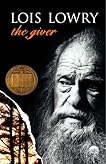
The Giver by Lois Lowry

Here is another of the books I read this summer that I thought I would comment on. It's pretty easy to say why I chose it for my list - I have heard about this book for years, but it came out just a little bit after I was in junior high, so I never read it in school, as I think many students do now. It also won a Newbery Medal.
The Giver is the story of Jonas, who lives in a Community where there is no strife, no real pain or fear, no war. Society has become very strictly controlled in order to eliminate these things. Lowry does a decent job of showing how the powers-that-be do this, through her descriptions of life through eleven-year-old Jonas's eyes. Sometimes she does have to tell the reader explicitly, or in some cases, when she doesn't explain something well, it can be confusing - I was pretty confused about the whole color issue, until that became really clear. I found the world that Lowry has created to be totally fascinating, and it brings up a lot of issues of giving up control over our lives in order to gain safety. I can see why it is popular at schools - it would give a lot to talk about.
While I found the world to be interesting, and I loved reading about Jonas's transition from an Eleven to a Twelve, the way the book ended really did nothing for me. This book had a lot of potential, but I felt like it went somewhere that did not take the issue to its fullest. I would still recommend it, just because the issues it brings up are interesting, and if you have a tween or teen to read it with, it would be an excellent discussion starter. However, because of the weak ending, I can't say that it is the best of this genre I have ever read.

Monday, July 27, 2009

Santa Olivia by Jacqueline Carey

I love Jacqueline Carey. She is one of my all-time favorite authors. This book begins a new series by her, separate from her beloved Terre D'Ange books. It is a very different story from those books, but I enjoyed it, and I am really looking forward to a sequel.
Loup Garron is born in the forgotten town of Santa Olivia, where she is raised by her single mother. She has been named by her father, who had to flee while her mother was pregnant with her - he was an enigma, a man who had been genetically engineered, told he could not have children. Loup's mother and her older half-brother Tommy teach her how to be "careful" - she is not like other children. Loup has no fear, which makes her do things that seem strange to others. She also is incredibly fast and strong. She learns how to hide these things, because if the soldiers stationed at the base discovered who she was, she would disappear. Santa Olivia is not on any map, not anymore. The people who live there have been forgotten by the rest of America, and they are allowed no contact with the outside world. But as a teenager, Loup can no longer keep quiet who she is, although she still manages to hide it from the soldiers. She begins to plan a way to help the people of Santa Olivia.
Loup's character is fascinating, Carey does a great job of making her seem very human, but slightly different at the same time. I loved the actions that Loup and her orphan family, the Santitos, plan and execute. They're like a little team of superheroes, even though Loup is the only one with any supernatural powers. Besides Loup's actions against the soldiers, boxing is the other main focus of the book. I am not a fan of boxing, however, Carey kept this part of the book interesting enough to keep my focus. Overall, this was a fantastic book, and had a few surprises that I was not expecting. I am genuinely looking forward to the next story about Loup, as she learns more about who she is.
Oh, and this is my final book for the Pub 2009 Challenge. Maybe one day I'll get a wrap-up post up.

Saturday, May 30, 2009

Hominids by Robert J Sawyer

Hominids won the Hugo Award in 2003, which led me to pick it up to bring me a smidgen closer to completing my 999 Challenge. (My book list for the challenge is here.) I think that I have liked this one the best of the Hugo Award winners that I have read so far. I even wanted to continue reading the series that this book begins, but due to some unfortunate circumstances, neither of the two copies of the second book in my library system are available. But I suppose it will stay on my reading list, and maybe one day I'll finish the series.
Hominids is an excellent example of speculative science fiction. What if parallel worlds exist? What if there was some way to bridge the gap between worlds? What might we find? In Hominids, it is not the human race on the world as we know it that manages to bridge this gap. We are simply the recipients. It is a Neanderthal named Ponter Bodditt, a quantum physicist in his own world, who comes to our dimension. In his world Neanderthals were the surviving species, while Homo Sapiens died out. While in our world, Ponter must figure out how to communicate and survive (he is helped tremendously by an advanced piece of A-I technology that learns languages and can communicate for him), while the people he meets have to figure out what this means for our world. And back in Ponter's world, his best friend and business partner must fight off unexpected accusations of murder, stemming from Ponter's disappearence.
This really was an incredibly fascinating, enjoyable read. I loved reading about the Neanderthal's world, as created by Sawyer. He does an excellent job of giving the reader a glimpse of that world through the trial against Ponter's partner, Adikor. And reexamining the human race through the eyes of someone close to us, but not the same, brings up some really interesting questions. The story itself is fast-moving and very satisfying, all leading me to want to continue the series! Ah well, I'll just have to keep this one in mind.

Friday, April 24, 2009

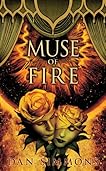
Muse of Fire by Dan Simmons

This was my final read during the Read-A-Thon, the book I spend the last hour and a half reading. It is novella-sized, just a little over 100 pages, and I wanted something that I could finish during that last stretch. Unfortunately, I forgot that you have to pay attention when you read a book by Dan Simmons, so I found myself re-reading passages that my sleepy brain did not understand the first time through. I did finish it by the end.
Reading Dan Simmons is always interesting - he loves to just drop you into the world that he has created for the story, and you have to read carefully so as to not miss any clues about what is going on. This book is no different. It is narrated by Wilbr, a 20 SEY old man (what is SEY, you ask? not sure, Simmons hardly ever outright explains things like that - if I had been less sleepy, I'm sure I would have figured it out) who is a member of a traveling Shakespeare troupe. They travel the galaxy on their ship, the Muse of Fire, performing for the human slaves on the various worlds that the human race can now be found on. All human are slaves, for the most part. There is no real culture or technology any more. There is religion, and obviously there is Shakespeare, but otherwise the human race exists only as drones working for the higher alien beings. The book begins when the Archons, the race of aliens that supervise the humans, request to see a performance of the troupe. This has never happened before. The group realizes they are being tested somehow, and in some way, the fate of the entire human race now rests in their hands.
One thing that you have to love about Simmons' books is that he loves literature, and so do his characters. Obviously Shakespeare is central to this story, and it is interesting how he juxtaposes the Bard's work with a future culture-less humanity. It makes you wonder how Shakespeare survived for so long in this future as it is. This book is really about the redemptive power of art, or literature, and it was a beautiful, comforting read.

Wednesday, April 22, 2009

Spin by Robert Charles Wilson

Spin follows the lives of three friends, beginning when they are twelve and thirteen. The story is told by Tyler Dupree, and we follow what is happening to him in his "present" time, at the same time as he is telling us about his past. It makes for some very suspenseful reading.
Tyler's story of his past begins with the night the stars disappear. He is spending the evening with his two closest friends, the twins Jason and Diane. That October night begins what will later be referred to as the Spin. As the human race deals with this strange phenomenon, they make unsettling discoveries about what it means for Earth and its relationship with the rest of the universe. Because they discover that the Spin membrane (as it comes to be called) not only surrounds the Earth and blocks its view of the rest of the universe - it also effectively stops time for Earth. Each year on Earth is now equivalent to something like 100 million years in the universe, meaning that the sun is aging much faster relative to Earth, and within a few decades will destroy the Earth.
The glimpses we are given of the present, while hearing the history of the Spin from Tyler, make certain things in the story clear. But it leaves you wondering so much, so that you can't wait to get to that part of Tyler's history and find out what happened. I really was drawn into this book, and enjoyed it tremendously. Robert Charles Wilson will definitely be an author that I look for from now on.
I read this book for my 999 Challenge, because it won a Hugo Award in 2006. My full list of books to read for the challenge is here. Robert Charles Wilson is also a new author for me, so this is another one for the New Author Challenge. Oh, and this is my second "S" for the Read Your Name Challenge (just J and I to go!).

Friday, April 3, 2009

Rainbows End by Vernor Vinge

Rainbows End won the 2008 Hugo Award, which is why I decided to pick it up and read it. I am a fan of science fiction, although it is not my favorite genre (that would be fantasy - similar, but not the same). This book is almost in the realm of speculative fiction, as it only takes place a little more than fifteen years in the future, and relies on the world remaining pretty much the same.
The book takes place over the course of several weeks, with most of the action happening in a single night. It is 2025, and our world looks very similar, although there are obvious differences. Technology has continued moving forward in leaps and bounds, paving the way for medical miracles and wearable computer hardware. Most young people have grown up with "wearables" - contact lenses and clothes that allow them to surf the internet and communicate as long as they are in range of the network (which means pretty much anywhere). The world has suffered from some horrendous events, which are mainly unspecified, but seem to be terrorist attacks as well as natural disasters. Two of the characters in the book are high-level Marines, and it is interesting to see how the past affects the way the military does things.
The main character is Robert Gu, a former world-renowned poet who lost much of his life to Alzheimer's. The medical establishment was able to cure him, and now he is making his way back in this strange new world. He lives with his son and daughter-in-law (the Marines), and their daughter Miri. In order to get up to speed with his clever grandaughter he goes to a local school for retraining - he is there with high school students and other elderly people who are trying to learn the same as him. From this point the plot gets rather complicated, and it is difficult to summarize without taking up paragraphs.
I really enjoyed Vinge's look at the future. It is easy to see how our world could become such a virtual place. One of the most entertaining and fascinating pieces of this future is the "belief circles". These are virtual realities created by fans of a particular author or work. An example from the book is the world that Terry Pratchett fans have created, which, if you tune in to their network, makes your world appear to be Discworld. It is very interactive and creative, as fans all over the world contribute to their particular belief circle to make it more fun for everyone. Vinge also does a great job of showing how not everyone is up to speed with all of the new technology. It's very much like today - some people are super internet-savvy, while others barely know how to use a mouse.
This was a great read, and I would recommend it to any science fiction fans, or anyone interested in speculative fiction. I read it for my 999 Challenge, for which I am reading award-winning books. It is also my "V" book for the A-Z Challenge, and Vernor Vinge is a new author for me, so I am counting it for the New Author Challenge as well!

Thursday, March 19, 2009

The Hunger Games by Suzanne Collins

As much as I'd heard about this book, I really wasn't prepared to get sucked into quite so much. I read it in a day, which I would highly recommend. But if you don't have the time or inclination to do that, you will definitely have something to look forward to as you read some each day. This is a fantastic book. It had me captured within the first 20 pages - I was already telling my husband "You have got to read this book!"
The Hunger Games takes place in a future that has been ravaged by environmental and political storms, where the area that used to be known as North America is now known as Panem. Panem is divided up into twelve districts. These twelve districts are controlled by the Capital. They basically exist in order to provide food and other raw materials to satisfy the Capital's needs. District 12 is the poorest, the coal-mining district. Katniss is a sixteen-year-old resident of District 12, where she illegally hunts to provide food for her family, and she is allowed to because the powers that be in District 12 buy what she hunts as well. Katniss has been the "bread-winner" since her father died, taking care of her mother and 12-year-old sister, Prim.
So what are the Hunger Games? The Hunger Games are one of the ways that the Capital shows the Districts that it has complete power and control over them. Each year one boy and one girl between the ages of 12 and 18 are taken from each district. They are brought to an arena where they are forced to fight each other to the death. This is the best entertainment that the Capital can imagine, and the rest of the Districts are forced to watch as well. No one from District 12 has won in decades. Everyone prays that no one in their family will be have their name drawn. When Prim's name is drawn, Katniss knows that she must volunteer - she will not let her sister face that fate. And so the games begin.
I don't really want to say any more than that, although most people already know at least that much of the story. I'll just say that the games were a lot more like reality TV than I had expected, which raised the shock-value for me. Also, I loved the politics. Really good dystopian fiction always makes us question those things that our culture values. The Hunger Games does that for sure. Really I can't recommend this book enough. It is fantastic, and I can't wait to see where the next one (not out until September!) takes us.

Friday, November 14, 2008

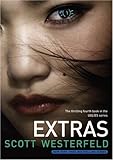
Extras by Scott Westerfeld

As I mentioned previously (a few posts ago), I wanted to review this book separately from the other books in the Uglies trilogy, because I felt more like it was a companion novel. The other three books all follow the character of Tally Youngblood, and center around the plot of the destruction of that world/way of life. This book takes place three years later, in a completely different city, and while Tally does show up eventually, she does not do so until two thirds of the story is already over.
The main character of Extras is Aya Fuse, a fifteen-year-old who is stuck being ugly because her parents still believe she should wait until she is sixteen to get any kind of surgery (in Aya's city, anyone can get whatever kind of plastic surgery they want, whenever they want - not just to be Pretty anymore). Not only is she Ugly, she's also an extra, a nobody who wishes she was famous. In her city, everyone has at least one hovercam that follows them and helps them document their world. Everyone is constantly uploading information to their own personal feed, and if enough people see their stuff and send it on, "kicking" it up higher in the feed numbers, that person becomes famous. Once a person is famous, they are constantly dealing with their celebrity status, as other less-famous people try to get stories about them. Aya's dream is to "kick" a huge story, one that will make her at least as famous as her older brother, and will save her from her fate as a boring nobody extra. She obviously finds her story, and Tally shows up to save them from themselves.
I really enjoyed this book. I even liked it better than the previous three books that took place in the series. It could probably be read without reading those others, but there will be a few inside jokes that would be lost on the reader. Other than that, Westerfeld explains the world well enough that it makes sense. I loved the fact that Aya's city seemed to be a commentary on the blogsphere. Maybe we aren't as obsessed with getting famous as everyone in her city is, but certainly there are plenty of "kickers" out there, as well as paparazzi and hangers-on trying to get famous from rubbing elbows with someone else. The book really does bring up some very valid issues about fame and popularity, and why they are important to some people, or not at all to others. It is an engaging read that would be enjoyed by fans of the series, as well as by teens who want an interesting book to read that will make them think (but not too much).

Sunday, November 9, 2008

Brave New World by Aldous Huxley

The last time I read this book, I did so all in one sitting. After beginning it again, I can remember why. It begins with descriptions of the new way of making humans in this futuristic, dystopian world. We discover in the first few pages that no longer are people born, they are decanted from bottles, where they are grown from the very tiniest embryo. Not only that, but their predestination for their station in life is determined before they leave the bottle, and so the conditioning begins while they are still a fetus. It is just creepy. Huxley does a fantastic job in describing this world, and when he describes how the concept of parents is absolutely obscene, we can understand why. The next rather horrifying thing that we learn about this world is that "everyone belongs to everyone", which really just seems to mean that the men can have sex with whatever woman they want, and the women don't really get to say no. All of this preconditioning and the idea of sex being meaningless, creating no attachments between people for any reason, is supposedly to produce a happy population. And it seems to work.
The best, and scariest, part of Brave New World is the fact that most people do not seem to mind the state of things at all. Their world is at peace, they have a job that they have been conditioned since before birth to like, they have the drug soma available to them, and they never have to be alone (in fact, they are never supposed to be alone). Even those people who are deliberately stunted before birth, who are created for menial jobs, do not have any interest in knowing the truth about their reality, and would rather just be happy with what they have. Only the Alphas, and perhaps the Betas, the people who have been conditioned to do the tasks that require individuality and intelligence, ever have any doubts about their world. But how can you go against a government that merely has the best interests of humanity at heart?
After just reviewing the Uglies series, I have to acknowledge that Scott Westerfeld was definitely influenced by Brave New World. It is clear that his book is written for teens, however, and while Brave New World is often read in high school, it was not written for a teenage readership. It may be difficult for some teens to understand, but should be included on everyone's reading list. Reading about the extremes that a society can go to is always fascinating.

Saturday, November 8, 2008

Uglies Trilogy by Scott Westerfeld

For awhile now I have been reviewing series as a whole, rather than as separate books, at least, I do if the whole series has been published already. I find that for a lot of teen and children's series, reviewing them individually gets seriously repetitive and annoying. So I was waiting to review Scott Westerfeld's Uglies series until I finished Extras. But now that I'm reading Extras, I'm realizing that it is more of a companion novel, and not so much part of the series. I would like to review it separately, so I might as well go ahead and review the rest of the books, since I finished Specials a few weeks ago.
The first time I saw Uglies, I was hooked by the cover. After reading the back cover, I was intrigued, but I could also see how such a book could be absolutely terrible. So I never bothered reading any of them until they were on a list for a class I took on teen materials over the summer. I really enjoyed all three books, and as they are easy to read, I zipped through each one.
The main character of all three books is Tally Youngblood. Uglies begins when she is fifteen, just waiting for her sixteenth birthday, when she will be made Pretty. In this alternate future, everyone undergoes the surgery at sixteen that makes them perfectly beautiful, making everyone theoretically equal. It is the belief of the controllers of this society that if everyone looks the same, and has the same opportunities, there will be no strife. But there are other, hidden controls put on the population that keeps them in line. Tally hates being an Ugly, and she doesn't even have any friends who are Uglies anymore, as she has a later birthday than all of them. When she meets Shay, another soon-to-be sixteen-year-old, she latches on to her like a lifeline. Shay tells her about David, someone who lives in the Wild outside of the city. This seems incomprehensible to Tally, and she thinks that Shay is insane for wanting to leave the promise of becoming Pretty. When Shay makes her escape, the city controllers force Tally to make a choice: betray her friend by following her, or never become Pretty.
From there Tally simply seems to be forced into one crappy situation after another. In all three books she never seems to have much control over her decisions, and is constantly forced to betray someone. But after learning the truth about the world that she lives in in Uglies, she knows that she can do the right thing, even though she constantly has someone mucking around in her brain and changing her body with surgery without her permission.
The world that Westerfeld creates is really interesting. He does a decent job of explaining how such a world could actually function, without going into too much detail. My favorite part of the series is the fact that it brings up the issue of control, and what it means to be under control. Is it better to live in a totally controlled society, but one with complete peace? Who gets to decide what constitutes beauty, or what makes something fun? Is it right to buck a government who is lying to its people, even though the truth might be more frightening than the lie? These are the questions Tally faces, and I like the theme of insurrection and government take-down. The issue of being Pretty is not addressed as cleanly as I would have liked. The government in the books makes the case for biology - Pretties are created the way they are because that is what our biology says is attractive. The issue of what makes someone beautiful is addressed peripherally; taken further, this could have been a very interesting concept.
Overall, I have to say I did enjoy the series, and I do love the theme of questioning authority and the accepted way-things-are. These are good books for teens who are looking for a fun read that also has something a little bit deeper (but not too deep). I'm looking forward to finishing Extras, and comparing it to the rest.

Wednesday, December 19, 2007

Lullaby by Chuck Palahniuk

I have never read any other books by Palahniuk, although I have thought about reading Fight Club before. This one was suggested as a compliment to the non-fiction book that we are reading in our book club (Collapse by Jared Diamond). The idea is to go for post-apocalyptic type novels, since Collapse is about the destruction of human societies as a result of environmental factors, and how humans react to them. Hence our choice of a not-quite-post-apocalyptic story that is about ethics and morality, about who gets to decide who lives and who dies; it's about the constant need for power that all humans have.
The book reveals its plot over time. The narrator is telling the story, but he occasionally brings the reader into his present time, which forces you to try to figure out what has happened in the mean time. The narrator is a man who has discovered a culling song, a magic spell that was sung to dying warriors or sick elders to help them pass into the next world. It is now found in a book of children's poems, and is sung to them as a lullaby, killing them in their sleep without the parents ever understanding what was responsible for their deaths. He makes it his mission to destroy every copy of the book that was published that contains the culling song. Meanwhile, he has to control his own growing desire to use the song that he now knows causes death. Involved in his story are a real estate agent who deals in haunted houses, a New-Age witch, and her vegan, eco-terrorist boyfriend.
The story makes some very surprising turns before the end, but by the time it ends, it has arrived where you expected it to. Palahniuk can be very difficult to read at times; his descriptions are occasionally incredibly gruesome, and some of the violence seems a little bit unnecessary. But I think that parts are purposefully difficult to read. It should be difficult for us to confront our inability to be silent and think for ourselves. It should be difficult for us to consider how we might handle ourselves if we had the power to kill with our mind, if we had been responsible, unknowingly, for the deaths of people that we loved. Lullaby forces you to think about the choices that we make, and to think about who is ultimately responsible for our feelings and desires.