Wednesday, November 4, 2009

The Year of the Flood by Margaret Atwood

When I first read about The Year of the Flood, and that it takes place in the same world as Oryx and Crake, I was intrigued. The world of these two books is a future of our world, around fifty years in the future, I think. So much of it is very similar, and what isn't the same as our world is still recognizable. I read Oryx and Crake when it came out a few years ago. I liked it, but it did not become a favorite of mine. It stuck with me, and yet it did not mean very much to me. As a result, I did not remember many details.
As a result, it took me a while to recognize that The Year of the Flood not only takes place in the same world as Oryx and Crake, but it also takes place over pretty much the exact same time period. The Year of the Flood is not a sequel, nor is Oryx and Crake a prequel - they are more like companion novels. I may have to go back and reread Oryx and Crake now, as I feel like I may see it in a different light.
I love Margaret Atwood's writing style. The Handmaid's Tale is my favorite book, and I have read many of her other books over the years. In this book, as in all of her others, Atwood simply drops you right into the story, and begins to describe the world from the point of view of one or more of the characters. In a science fiction-like story such as this one, this makes things a bit disorienting at first. Atwood leaves it up to her readers to piece together the meanings of many words - although the world is very similar to ours, many things exist in it that do not in our time, and so there are new words for many objects and ideas. But Atwood is an excellent writer, allowing the reader to pick up on these things as she goes along.
The Year of the Flood is told from the points of view of two different characters, Toby and Ren, who have both survived the plague that wiped out humanity, known as the Waterless Flood. Interspersed between their chapters are sermons given by the leader of the Gods Gardeners, Adam One. Toby and Ren give us a picture of what their life is in the present tense, as well as telling us about their past. The stories of their pasts move forward until at the end of the book, they meet with the present. I always really enjoy this novel structure, as it is suspenseful in a way, but you also know the ending.
I would have to say that I liked this book a lot better than Oryx and Crake, but it would be really interesting to reread that one now that I've read this one. They are incredibly different books, told by characters who are vastly different from each other, and experience the world in a very different way. Atwood's views of the future are always interesting, and are critical of many aspects of our present societies. I highly recommend this book to everyone, not just fans of her work.

Friday, October 30, 2009

The Silent Man by Alex Berenson

John Wells is a CIA agent who has had a rough time the past couple of years. In two previous books by Berenson, The Faithful Spy and The Ghost War, Wells is the hero who must save the world in some way. And The Silent Man is no different. I have not read the other two books, but I can vouch for the fact that this book stands on its own - no need to read the other two first.
The Silent Man is the story of an Iraqi man who becomes a jihadi after his family is killed during the American invasion of Iraq. He connects with various people around the world who help him to acquire nuclear material in the form of bombs from Russia, which he plans on using to make his own bomb. In the beginning of the book, there is no connection between this plot and Wells, but after Wells attempts a mission of revenge against a man who tried to have him and his fiance killed, he becomes very involved. Wells is unable to accomplish the act of vengeance that he seeks against Pierre Kowalski, and in order to save himself, Kowalski offers Wells information about the terrorists. From there it is a tense race against the clock.
I enjoyed this book, and I can see why people are fans of this genre. I must admit that I am not a fan of thrillers of this sort, and even though I read and enjoy them occasionally, I doubt they will ever be my favorite. I mostly find them depressing and rather cynical, especially because I feel like the bad guys are always stereotypical. But I guess they have to be recognizable, so in this day and age, the bad guys are typically Muslim terrorists. Anyways, this is a good example of the genre, and it is definitely a page-turner. The characters have a decent amount of depth, even the bad guys, which makes reading it much more interesting. All of the characters are conflicted in some way, especially John Wells. He has had more time to develop as a character through the series, and he is a very complicated man. Not your typical hero at all. But he does his best, and when that involves saving the world, who can complain?
This is another book that qualifies for the Suspense and Thriller Reading Challenge, which I am surely not going to finish by the end of the year. But whatever. This one qualifies as both a Spy Thriller and a Terrorist Thriller, but I think I will use it for the former. A Spy Thriller is "where the hero is generally a government agent who must take violent action against agents of a rival government or (in recent years) terrorists."

Thursday, October 29, 2009

The Tudor Rose by Margaret Campbell Barnes

The Tudor Rose is the story of Elizabeth of York, the mother of Henry the Eighth. This telling begins when she is a teenager, and is to be wed to the Dauphin of France. Although this marriage falls through, pening the book this way gives the reader a good glimpse of what the rest of the book is going to focus on. After the King, her father, dies, and her brothers are presumably dead, she is basically the heir to the throne of England. Her uncle Richard takes the throne after imprisoning her two young brothers in the Tower, yet she still has the stronger claim. Therefore she becomes the prize to be won, along with the rightful rule of England.
The first half of the book focuses on the struggle for the throne, which ends with the victory of Henry Tudor, who will become King Henry the Seventh. From there on, the story is of her marriage and her children. It is rich in historical detail, although sometimes the way that detail is conveyed is told rather than shown. That was my main difficulty with really getting into the story - the author tends to have her main characters throw in history for us, but it sounds incredibly forced. And in some cases it is clear that the conversations are probably not in anyway historically accurate, but are there to fill the reader in on some details. Despite this, it is an enjoyable book, and as my mother is already reading and enjoying my copy, I can definitely say that fans of historical fiction will like this one.

Monday, October 19, 2009

Arc of Justice: A saga of race, civil rights, and murder in the Jazz Age by Kevin Boyle

I picked this book up for my woefully unfinished 999 Challenge. It won the National Book Award for Nonfiction in 2004, which is why it made it onto my list. (You can look at my whole list here. I think I've only read about 10% of them!) It also finishes off my New Author Challenge, which is exciting. Good thing that one doesn't take nearly as much work.
Arc of Justice is the story of Ossian Sweet and his family, and the murder trial they become involved in when the Sweet family attempts to move into a part of Detroit where they are not welcome. The Sweet family is black, and in 1920's Detroit, this means they cannot live where they choose, especially following the race-related violence of 1924 and 1925. When a mob gathers outside of their new home and begins throwing rocks and getting more and more violent, shots are fired, although by whom it is never fully clear. Dr. Sweet had filled his house with friends to help defend it from the violence he knew was coming. When one man in the mob dies after being shot from the house, the eleven people in the house, including Ossian's wife and two of his brothers, are taken into custody and eventually charged with murder.
This book is not just the story of the Sweet family and the trial, however. It is a story of race relations in the northern urban areas of America in the 1920's. Boyle does a tremendous job bringing all aspects of the story together to educate us on this issue. I am continually amazed by how little I know about the history of race relations in this country. This book is a must-read for anyone who wants to know more about our recent past.

Sunday, October 18, 2009

To Serve Them All My Days by RF Delderfield

Towards the end of World War I, David Powlett-Jones is discharged after being in the hospital, injured and shell-shocked, for months. He is sent to Bamfylde, a private school in Devon, to teach history to boys who are less than ten years his junior. He has no experience as a teacher, and does not even have a degree, but the doctor felt that this would be the best remedy for the soul-sickness that David suffers from after spending three years in the trenches. And soon David comes to realize that Bamfylde was just what he needed.
The story of David Powlett-Jones and Bamfylde covers the time between the two World Wars, and follows David through the ups and downs of his life, as well as the ups and downs of Bamfylde, and England as a whole. Delderfield is a wonderful storyteller, and I enjoyed this book as much as I enjoyed God is an Englishman. The only difficulty I had with reading this book was that I am not British. So much of the politics of that time period that Delderfield includes, but chooses not to explain, went over my head. Obviously he is writing this for a British audience who would know that names he is speaking of. There are a few other things that come up like this, that as an American I had to work harder to understand. But that does not lessen the book's interest for me. It is just a comment on one of the difficulties of reading it. Apparently there is a BBC miniseries based on the book, which now I'll have to check out. Delderfield's stories, although they seem to be about simple subjects, are definitely engrossing, and a wonderful experience to read.

Wednesday, October 7, 2009

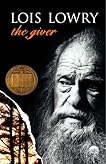
The Giver by Lois Lowry

Here is another of the books I read this summer that I thought I would comment on. It's pretty easy to say why I chose it for my list - I have heard about this book for years, but it came out just a little bit after I was in junior high, so I never read it in school, as I think many students do now. It also won a Newbery Medal.
The Giver is the story of Jonas, who lives in a Community where there is no strife, no real pain or fear, no war. Society has become very strictly controlled in order to eliminate these things. Lowry does a decent job of showing how the powers-that-be do this, through her descriptions of life through eleven-year-old Jonas's eyes. Sometimes she does have to tell the reader explicitly, or in some cases, when she doesn't explain something well, it can be confusing - I was pretty confused about the whole color issue, until that became really clear. I found the world that Lowry has created to be totally fascinating, and it brings up a lot of issues of giving up control over our lives in order to gain safety. I can see why it is popular at schools - it would give a lot to talk about.
While I found the world to be interesting, and I loved reading about Jonas's transition from an Eleven to a Twelve, the way the book ended really did nothing for me. This book had a lot of potential, but I felt like it went somewhere that did not take the issue to its fullest. I would still recommend it, just because the issues it brings up are interesting, and if you have a tween or teen to read it with, it would be an excellent discussion starter. However, because of the weak ending, I can't say that it is the best of this genre I have ever read.

Tuesday, October 6, 2009

Good Masters! Sweet Ladies! Voices from a Medieval Village by Laura Amy Schlitz, illustrated by Robert Byrd

This was one of those books I read over the summer for my Tween Materials class. I picked it up because it was a Newbery Medal winner (2008) and also because it was non-fiction. For the final project for the class I had to read and review 50 books and other materials for tweens, half of which had to be fiction. The majority of my books were fiction, so I needed a few non-fiction titles to break it up.
As I obviously am not reviewing every book that I read this summer here, I chose to review this one for a specific reason. That reason is the honesty of the portrayal of medieval life, made accesible to kids. Good Masters! Sweet Ladies! is written in an interesting format - it is a series of plays (mostly monologues, but a few for two people) written for students at a Middle School. Each of these plays is a portrait of an individual in this medieval village, all of which are first-person accounts by narrators that can be assumed to be the same age as the students reading the book. I expected something fun and light-hearted, and what I got was a very good lesson in what medieval life might really have been like. Not really fun and light-hearted at all, but difficult in many ways, even for the young people of the time. In addition to the plays, Schlitz also includes background information to help young readers learn more about the time period. This is truly an excellent book to include in any lesson about medieval history, or to give to any young person who wants to learn more about this time period.

Monday, October 5, 2009

Annie's Ghosts: A Journey Into a Family Secret by Steve Luxenberg

The story of Annie Cohen is a tragedy, a story of mental illness and physical disability, of family abandonment and secrets. Steve Luxenberg first discovered Annie's story when his mother mentioned having a sister to a doctor in her old age. Steve and his siblings grew up being told that their mother was an only child, so the casual mention of a sister, even one that was put in an institution at the age of two, was rather shocking. It wasn't until after his mother's death that Luxenberg discovered Annie's true identity - she had grown up with his mother, had not been institutionalized until the age of 21, when his mother was 23. But in the family history according to Beth Luxenberg, she did not exist.
Annie's Ghosts is Luxenberg's attempts to piece together Annie's history. He includes not only family details, but also details about the history of services to people with mental illness and mental and physical disabilities. Not only is Luxenberg trying to discover the truth about an aunt that he never knew, he is also searching to find the answer to why his mother would have kept such an enormous fact about her family a secret. He is not even sure that his father knew about Annie, or which of his mom's friends knew. Steve has to reconcile this part of his mother with the woman he knew and loved, and he begins to reconsider some family memories he himself holds.
This is a fascinating story of a single family's history, and all of the little details that tie into that history. Luxenberg reconnects with cousins he never knew, and discovers more about the tiny Eastern European village that his grandparents came from than his family had ever told him. Reading this book forces the reader to compare their own family to the Luxenbergs. Are there secrets that we know nothing about hiding in our history?

Wednesday, September 30, 2009

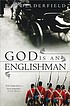
God Is an Englishman by RF Delderfield

I was not sure what to expect of this book, but when I received it and saw how large it was, I was certainly surprised. I was further surprised by how engrossing a book it actually was. Giving a plot outline really doesn't convey how good of a book this is, but I'll go ahead and try anyway.
God Is an Englishman tells the story of Adam Swann and his rise to prominence in London in the 1860's. His story begins when he makes the decision to end his career as a soldier and begin his life as a businessman, at the age of thirty-one. His chosen field of commerce is transportation, where he decides to fill the gap that the great trains of that era cannot. At the same time that he is establishing his business, he meets Henrietta, and from their first meeting he is captivated by her. Although she is much younger than him, she is a strong-willed woman, and circumstances conspire to create a situation in which he marries her after only knowing her for a few months. Thus begins the story of not only their life together, but the story of the newly formed Swann-on-Wheels transportation company.
The historical detail in this book is truly fascinating. Even when Delderfield is going through details that should be tedious - train schedules, shipping and transportation issues - he makes it interesting. Adam Swann is a fantastic character, one that you love to root for. And I loved following his marriage and family life, as he and Henrietta grow to know and truly love each other throughout the years. This is the first book in a trilogy, one I am going to have to follow through the rest of the series.

Thursday, September 10, 2009

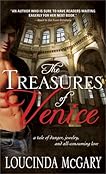
The Treasures of Venice by Loucinda McGary

Samantha Lewis is in Venice, taking a tour by herself that was supposed to have been her honeymoon. When she is approached by a handsome stranger who pretends to be meeting her at a cafe, she decides to play along. His name is Kiernan Fitzgerald, and he is definitely more than he seems. Sam is instantly drawn to him, but she feels crazy for getting so attached after just an hour or two. When he reappears in her hotel room later that night, injured and needing her help, she is immediately drawn into his troubles.
Kiernan is looking for the Jewels of the Madonna. His sister was also searching for the Jewels, until she was kidnapped. Now the only way for Kiernan to save her is to find them himself and turn them over to the kidnappers. He doesn't want to get anyone else involved, but he can't seem to stay away from Sam. They are drawn to each other in a way neither can explain, and so they stop trying to fight it, and start trying to save Kiernan's sister, before it's too late.
Besides being a story told in the present time, The Treasures of Venice is also told in flashbacks to fifteenth century Venice, where the reader learns the story behind the Jewels that Kiernan seeks. The lovers in that story have some striking similarities to Kiernan and Sam - coincidence? As Sam and Kiernan get closer to the Jewels, and to each other, they both begin to wonder if they have some sort of deeper connection that goes beyond the present time. This element of past lives adds another dimension to the story and the mystery, making for a more interesting read. I liked the parallels between the two stories. This is an exciting, romantic adventure book that any readers of romance will enjoy.