Thursday, January 29, 2009

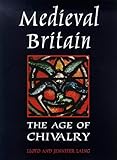
Medieval Britain: The Age of Chivalry by Lloyd and Jennifer Laing

This book is my second read for the Medieval Challenge, and the first of the non-fiction books that I have chosen to read for it.
Medieval Britain: The Age of Chivalry is laid out like a text book, and covers the time period from the Norman Conquest in the 1000's to the 1500's. Each chapter focuses on a different area of Medieval life, focusing on Britain, but also giving details about Europe at points. The chapter headings are Society; Castles; The Countryside; The Church; Towns; Trade and Communications; Science and Technology, Superstition and Medicine; Leisure and Fashion; and Intellectual and Artistic Endeavor. This gives you an idea of what information this text has to offer.
Although the information given in this book is interesting, I found it to be too broad of an overview for what I was hoping. This book is definitely a good starting point for someone looking to read more about medieval times. I will have to explore further for a book that delves more deeply into this time period, however.

Wednesday, January 28, 2009

Library Loot - January 28, 2009

This week brought more family planning books, another textbook, a couple sci-fi/fantasy titles, and a book that I had checked out before, but had to return without reading.
Here they are:
  • Scribes, Script and Books by Leila Avrin (for my History of Books and Libraries class)
  • Anathem by Neal Stephenson (this is a large, large science fiction book)
  • Hunter's Oath by Michelle West (for the Reading My Name Challenge, and because I wanted to re-read it)
  • Unaccustomed Earth by Jhumpa Lahiri (for the second time, maybe I'll actually get around to reading it!)
  • Before Your Pregnancy by Amy Ogle and Lisa Mazzullo
  • Fully Fertile by Tamara Quinn, Elisabeth Heller and Jeanie Lee Bussell
My stacks keep growing, and I'm not finishing books as fast right now! Ack. I'll just hope my Library Loot posts get smaller, because otherwise I'll never finish everything.

Tuesday, January 27, 2009

Themed Reading Challenge 2009

Okay, another challenge beginning in February, and I can't help but join. This is the Themed Reading Challenge, running from February 1st to July 31st.
The goal is to read books from your TBR pile that have a theme. These challenges have been really good for me, totally helping me get through this bookcase full of books that I own that I've never read.
There are three levels of participation, and I am joining at the lowest: four books focusing on one theme. My theme is, in one word, consumerism. The four books are non-fiction, and are in one way or another connected to the idea of consumerism or globalization.
So, here they are (in no particular order):
  • The World is Flat by Thomas Friedman
  • Branded by Alissa Quart
  • The Omnivore's Dilemma by Michael Pollan
  • Not Buying It by Judith Levine
I'm expecting good things. These are all books that I want to read. I've had Branded lying around for more than five years now, but I do want to read it. Yay for challenges!

Thursday, January 22, 2009

Reading My Name Challenge

I made a rule for myself that I would not sign up for any more challenges, with the exception of challenges that have not yet started. Hence my signing up for the Reading My Name Challenge - it begins February 1st! The goal is to read at least two books by authors who share your first name or book titles with your name in them. I decided to go with my married last name, West. It's easier to search in the library catalog, and a little more common, so I have more to choose from.

I will be reading two fantasy books my Michelle Sagara West: Hunter's Oath and Hunter's Death.
I read Hunter's Oath years ago, but at the time I was not able to find the sequel (maybe it wasn't out yet?), so now I can re-read it and finish the series! This could change, but this is what I plan on doing at this point.

Wednesday, January 21, 2009

Library Loot - January 21, 2009

Another fairly big library week, although this should be the last big one for awhile. So what did I get?
  • Women in Early Medieval Europe by Lisa M Bitel (for the Medieval Challenge)
  • Canterbury Tales by Geoffrey Chaucer (also for the Medieval Challenge)
  • Inkheart by Cornelia Funke (I can't seem to stop reading books that will be made into movies - even though I usually hate the movies!)
  • Eon: Dragoneye Reborn by Alison Goodman (this one was on a best of 2008 list for teens, so I thought I'd check it out)
  • The Aurora County All-Stars by Deborah Wiles (I think this one may have been from a best of 2007 list for kids)
  • Developing Library and Information Center Collections by G Edward Evans (for a class, Collection Development)
  • The Book: the life story of a technology by Nicole Howard (another book for my History of Books and Libraries class)
And there you have it. I do anticipate actually getting to all of these, although I may not be able to get the medieval ones read by the time the challenge is up. But it won't be for lack of trying!

Tuesday, January 20, 2009

The Seeker Chronicles by Betsy James

The Seeker Chronicles is the name of the series including the books Long Night Dance, Dark Heart, and Listening at the Gate, by Betsy James. These books have been in my to-read pile for months, and I am so glad that I finally got around to reading them. The series as a whole is tremendous, but I think that my favorite book of the three is the last one.
In Long Night Dance, the first book of the series, we meet Kat. Kat is the daughter of an Upslope man, a Leagueman. The culture of the Leaguemen is incredibly restrictive - singing and dancing are forbidden, women are kept covered and do not speak to strangers. Kat has taken care of her father and brother since her mother died, and she knows that she will be expected to do the same for a husband someday. Then when she is twelve she hears the Rigi's song. And her life changes. Long Night Dance begins when Kat is 15. It is a relatively short book, easy to read in just a sitting or two. I'm going to give away some of the plot in order to talk about the series as a whole, but I don't think it will change how you read the book.
The second book in series is Dark Heart, and it begins a year or so after Long Night Dance finishes. Kat discovers her mother's people at the end of Long Night Dance and travels with them to the hills where they live, in order to learn better who she is. But she does not fit in well in the town of Creek, and she struggles with their rules and rites of passage. There she also meets a young man who makes her question her love for Nall, the man she left in Downshore. Dark Heart is the story of her seeking who she is, and what she must do.
Listening at the Gate could almost be read without reading the first two books. It is much longer than either of them - three times as long probably, and contains an opening section that describes what happened in the two books that came before it. This book is the story of Kat's return to Downshore. She thinks that she has figured herself out, that she is ready to be a woman on her own terms. She leaves her family in Creek to return to Nall, the man she loves. But war and strife have come to Downshore, in the form of her father's people, the leaguemen. And the Rigi have their own war brewing. Kat and Nall must work together to try and heal their home.
Describing the plots of the books does not to much to explain how beautiful they are, how immersive to read. James is incredibly poetic, her words are a joy to read, not just for the story they tell. But the story is universal - it is of a girl who is trying to find who she is for herself, but who keeps settling for what other people tell her she is, or must be. Every time she thinks she has the answer, she is proved wrong again, and must finally learn to accept herself as the flawed human being that she is. She also must learn that everyone is flawed in some way, but that does not keep us from loving each other. The world that James creates, with all of its myths and songs and culture is very satisfying. These are books about how love and hope can bring peace to struggle and madness - highly recommended to anyone who enjoys fantasy, or a lyrical and poetic writing style.

Monday, January 19, 2009

From the Stacks Challenge Wrap-Up

The From the Stacks Challenge was a great first challenge for me, perfect for forcing myself to pick up those books that I otherwise would not have read. This challenge ran from November 1st 2008 to January 31st of this year. So I finished with a week or two to spare. The goal was to read five books that we have on our shelves at home, that we've been meaning to read but haven't managed to get to, for whatever reason. I have a lot more than five books that qualify, but I the books I chose were mostly gifts that I was given, some more than two years ago. I think it is very necessary to read the books that are given to you as gifts, because somebody obviously went out of their way to choose that book for you.
The first book that I read for this challenge was actually not a gift, but one that I picked up because I had heard so much about it. It was The Curious Incident of the Dog in the Night Time by Mark Haddon. This one became one of my favorite reads of 2008 - I just loved it! And I'm so glad that I forced myself to read my copy of it. What a great way to begin this challenge!
The next book I read was also not a gift, but a signed first-edition that I had picked up for myself when I saw it on sale at the book store. It was Dragons of the Dwarven Depths by Margaret Weis and Tracy Hickman. I have to say that I do consider myself a Dragonlance fan, although not a huge one. I have enjoyed their books, but there are other series that I have loved more (The Deathgate Cycle is incredible, all fantasy fans should pick that one up at some point). This book was fun, very Dragonlance-y, but not great. Adding it to my collection of signed first editions meant more to me than reading the book itself, even after reading it.
I read Under the Net by Iris Murdoch for this challenge in December. This was a gift, one I received from my brother-in-law and his girlfriend for Christmas last year. They always choose thoughtful and interesting books, so I felt terrible for never getting around to reading their gifts. This was a fun read, very enjoyable both for the writing style and for the story.
I began the new year with another gift from J and A - Life of Pi by Yann Martel. This book is definitely on my list of favorite books now, and is probably the best book I've read so far this year. They actually got this book for me at least two Christmases ago! I can't believe I let it sit on my shelves for so long!
The final book I read for this challenge was a gift from my dad last Christmas - Crimes Against Nature by Robert F Kennedy Jr. I really enjoyed this one, and now when my dad asks me about it, I can actually discuss it with him, rather than making excuses for why I haven't read it yet!
I will definitely be keeping my eyes open for challenges in the future that are like this one. Anything that encourages me to read books that I own, rather than books from the library, is good. I still get tons from the library (just check out my Library Loot posts!) but at least my own bookshelf is not as neglected. Now I just have to figure out a way to encourage myself to read those books that I borrow from friends . . .

Sunday, January 18, 2009

Crimes Against Nature by Robert F Kennedy Jr

The subtitle to this book is "How George W Bush and His Corporate Pals are Plundering the Country and Hijacking Our Democracy." There's not really much more that needs to be said about what this book is about. Kennedy has a tremendous amount of data to back up this statement, and his writing lets you know that he feels pretty strongly about it. I would say he's pissed, as we should all be. I already knew vaguely of some instances where Bush's appointments for various government positions allowed corporate interests to basically take over, but Kennedy brings to light many many more perversions of power. This is an incredibly well-researched book, Kennedy obviously went to great lengths to make sure that he had the facts to back up what he knows was happening in our government.
It would be really interesting to see what has changed in the four years since this book was written. Parts of it have an almost mournful tone: Kennedy is telling us about what the Bush administration has done so far, and he is concerned about what is going to be affected in the future. It will also be interesting to see what will change with the new administration - most of Obama's environmental and scientific appointments seem to be people who can make the necessary changes. But there is still a big connection with the corporations, and in today's politics, that seems hard to change. This is an interesting factual read, although much has probably changed since the book first was published.
I read this book to finish up the From the Stack Challenge, and it also qualifies for the RYOB Challenge, since they're pretty much the same thing. I am also using this book for the Read Your Name Challenge. For reading my name, I am doing my full first name - Jessica. So this is my "C".

Friday, January 16, 2009

The News From Paraguay by Lily Tuck

This National Book Award Winner is historical fiction that takes place mostly in Paraguay, in the 1860's. The story mainly follows Ella Lynch, the young, beautiful Irish woman who comes home with the president's son after his trip to Europe. It is difficult to say whether or not Ella and Franco actually love each other, but they do stay together, though never marry, throughout the fifteen years that Ella is in Paraguay. During those fifteen years Ella gives birth to seven children, five of which live to be teenagers. Franco's father dies, giving him the opportunity to take control of the country and embroil it in a seemingly senseless war against the surrounding countries. Franco becomes a dictator, forcing his people to give up everything for his pointless war, becoming more and more paranoid, arresting and killing people for no reason. Ella continues to support him, more because she doesn't know what else to do, than because she actually believes in the cause. She considers leaving many times, but always stays, until the war has destroyed the entire country, killing almost all the men, including Franco himself.
I really enjoyed reading this book, although it wasn't necessarily due to the story. The book is written in a very interesting way - we are given brief glimpses of parts of the characters' lives, usually in short sections that are only a handful of paragraphs or less. This makes the story feel like it is moving very quickly. Tuck does not just focus on Ella and Franco, either, but gives us pictures of many of the other characters, major and minor, and leaves it up to the reader to make a whole story out of it. Her choices of what to show about each character are very deliberate - some of the characterizations seem rather shallow at first, but get deeper as we get more glimpses of them. This is one of those books that is more interesting to read for the way it is written, rather than for the story itself.
About the story - it is about real events, Ella and Franco did exist, as did many of the other characters in the book. I always find it fascinating to learn about history in this way, and also to learn about what came from history and what came from the mind of the author. In this case, events of the war are not particularly well documented, and many of the minor events were never documented. But the book is obviously well researched, and I think that Tuck does an excellent job of describing Paraguay during the 19th century. In the Author's Note she quotes a friend who says, "Nouns always trump adjectives, and in the phrase 'historical fiction' it is important to remember which of the two words is which."

Wednesday, January 14, 2009

Library Loot - January 14, 2009

Okay, so this week was a big one too. Last week it was seven, and I said that I normally only pick up three or four, but mysteriously I had nine waiting for me this week. So here they are:
  • The Oresteia by Aeschylus - for the Really Old Classics Challenge
  • The Pillars of the Earth by Ken Follett - for the Medieval Challenge
  • Le Morte D'Arthur by Sir Thomas Malory - also the Medieval Challenge
  • Ficciones by Jorge Luis Borges - I think I picked up this one for the Martel-Harper Challenge, not sure
  • History of Libraries in the Western World by Michael H Harris - first textbook of the new year! For the class History of Books and Libraries
  • Home by Marilynne Robinson - because I loved Gilead
  • Simply in Season by Mary Beth Lind and Cathleen Hockman-Wert - I love checking out good seasonal cookbooks
  • Taking Charge of Your Fertility by Toni Weschler - a little bit personal, but we are planning our family now! This one was recommended to me by my currently-pregnant cousin
  • Amber and Blood by Margaret Weis - because I love fantasy, and I'm always reading something from one series or another
Okay, that's that. Crazy list this week. We'll see how many of them I get read before having to take them back!