Saturday, December 20, 2008

Math Doesn't Suck by Danica McKellar

This is a fantastic book. It put me off a little bit at first with its teen-magazine-like cover, and its subtitle - "how to survive middle school math without losing your mind or breaking a nail". But McKellar does a terrific job of explaining a lot of difficult math issues in a way that is fun and makes sense. I read this book because I tutor kids who are mainly doing middle school level math. This book gave me a lot of ways to help explain things when kids are stuck.
One thing to know going into it, in case it's not obvious enough from the cover - this is a book geared entirely towards middle school girls. Middle school boys are not at a level of maturity where they can read a book that talks about cute boys, crushes, shopping, and make-up, and take it with a grain of salt. They simply wouldn't be able to get through it. The idea is to make girls feel like it's okay to be smart and good at math. So many girls feel "nerdy" if they're good at science or math, and nerdy is absolutely what most girls do not want to be in middle school. This book is for girls who are tempted to pretend they are someone else, just to be approved of. Math Doesn't Suck is full of examples of successful grown women who use math every day in their jobs, and are glamorous at the same time. The message here is "being smart is cool" and never dumb yourself down for other people. I admire McKellar for using her star power in this way - and I wish her and all the middle schoolers who read this book luck. Middle school is difficult, but if girls can use this book to help them gain the confidence they need, they'll be on the right path.

Friday, December 19, 2008

Jack Plank Tells Tales by Natalie Babbitt

Jack Plank is an out-of-work pirate; he lost his job because he just wasn't very good at it, and times were getting hard for his ship's crew. So they let him off in a Caribbean town called Saltwash, where he tries to make his way. He takes a room at a boardinghouse where they know he was a pirate, and they give him a week or so to find a job and prove that he plans on being a productive member of society.
What follows is a series of stories told by Jack, each one outlining why he is not able to do a specific job - he has a story for each one, although sometimes the story does not seem to directly relate to the job itself, or why he is unable to do it. But in the end, Jack discovers what he is able to do - tell a story!
The stories are whimsical and often silly, as are his audience's responses to his tales. This book was written for kids in grades two through six, but would probably be enjoyed by the younger ones more. It would also be a fun story to read aloud to, or along with first or second graders. It is not a book that would be enjoyed as much by every age, but for younger elementary school children, it's a great choice.

Thursday, December 18, 2008

Under the Net by Iris Murdoch

Here is my third entry for the From the Stacks Challenge. (Previous entries can be found with the label below.) This is one that I've had for about a year - it was a Christmas gift from my brother-in-law and his girlfriend last year, and it took signing up for a challenge to get me to read it. Not because I wasn't interested, it's just very difficult to get me to read my own books. That's specifically why I sign up for these sorts of challenges.
I knew nothing about this book, beyond the information anyone can glean from the cover print. The book was written in 1954 by Iris Murdoch, who wrote more than 20 books. This one takes place in London, presumably during the time that it was written. I found Under the Net to be more entertaining than I expected. The main character, Jake Donaghue, is a man who is afraid of hard work, who never has a job or a place to live, but manages to live well off the generosity of this friends. The only job he seems to do is as a translator for a french author. Jake wants to be a writer in his own right, but as mentioned before, he's not very good at actually working on something.
Jake's life changes when he is once again without a place to live, and gets in contact with his old girlfriend and her movie-star sister. This brings him back into contact with Hugo, the man who he broke off contact with years before. Jake has to come to terms with a variety of opinions he holds about these friends from his past before he can face his future.
I really enjoyed reading this book. It is hard to explain how funny the book is - there are parts that seem like some kind of movie caper or heist. Jake's character is very well drawn - you root for him even when he's behaving like an idiot. His friends are interesting and varied, and not like anyone I know. And once Mister Mars, the movie dog, joins him (in a very funny kidnap-the-dog scene), I was loving it. Written by someone less talented, this book could have been terrible, but Murdoch does a wonderful job telling the story with both humor and drama.

Wednesday, December 17, 2008

Brisingr by Christopher Paolini

I first picked up the Inheritance Cycle books when I was doing a project on books that were written by teens, last fall. While I was impressed that Eragon was written by a 15-year-old, it really wasn't very well written. It was fun to read, and if the story was derivative, well, what can you expect from a teenage fan of fantasy writing their first book? I did read the second book soon after, and found that the writing had gotten better. Brisingr is definitely readable, Paolini's style has improved, and I am still enjoying the story of Eragon and his dragon Saphira.
I was honestly really surprised by some of the turns the plot took in Eldest - I wondered to myself how Paolini was going to solve the quandries he had created. Nothing is really resolved in this book, but the plot definitely moves forward, and I have hope that Paolini will be able to resolve all of the loose ends satisfactorily in the fourth book. My main complaints about this third title are probably the same as my complaints for the second book. It feels as though Paolini is writing the book with a thesaurus at his side, and sometimes he seems to choose a word simply because it is larger and less well-known, not because it fits perfectly in a sentence. Similarly, his use of the dwarven, elvish, and other languages he creates for his world is ponderous at times.
I would recommend this series to any teen who enjoys fantasy, especially dragons. The book does not seem derivative if you have less to compare it to, and it exposes anyone who reads it to the themes of the hero's journey. This book is the least derivative so far - revelations about Eragon's true parentage make it so that he is no longer the son of Darth Vader with sibling he never knew of. We are no longer following as closely to a Star Wars plot-line, although, as mentioned above, it is still a story of the hero's journey, making it extremely recognizable to anyone who is well-read. These books are fun, although they could not be called light reading, and should be given a chance beyond just groaning about how similar they are to every other fantasy out there. They do stand on their own.

Friday, December 12, 2008

Textbook Round-Up (Part II) - Reference and Web Programming

Whew, I am finally done for the semester. Next semester I will only be taking two classes, so hopefully I won't be quite so overwhelmed with school.
In my last textbook post, I talked about all of the books used for my Intellectual Freedom and Youth course. This post will cover two classes, with only three books.
The first is the two-volume set Introduction to Reference Work, by William A Katz. These are very comprehensive books, covering all sorts of reference needs. Katz analyzes not only the source of the materials he discusses, but also the cost, and how they could be used at different types of libraries. The first volume covers all the necessary sources: encyclopedias, dictionaries, periodicals, ready reference, etc, etc. The second volume discusses actually doing reference work. My only complaint with these books was that the information on the internet was out-of-date. Really anything that was published in 2002 and talking about the internet is going to be behind, but some of the information seemed like they didn't even bother updating it for the 2002 edition. This was disappointing, to say the least. Other than that these books were an excellent match for the class, and would be very useful for any new librarian learning the ropes.
The only textbook used in my web programming class was HTML, XHTML & CSS, by Elizabeth Castro. This was a stellar book, one I would highly recommend to anyone who is learning how to work with any of the above languages. It is also excellent for reminders, in case your skills have become rusty. I even had the opportunity to recommend this book to a patron who was looking for a good book on the subject. The class was good, although I'm still not sure how it applies to my overall Library Science degree, and I doubt I will be pursuing web design in the future, but for learning about it, this book was great.
And that's another semester finished! Next semester it will be Collection Management, History of Library and Books, and Evaluation of Youth Services. I am not joking when I say I am really excited.

Monday, December 8, 2008

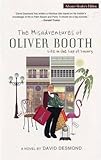
The Misadventures of Oliver Booth by David Desmond

Oliver Booth is one of those people that you either despise or feel sorry for, sometimes at the same time. His character has absolutely no redeeming qualities, and the author is quick to let you know that no one else on the planet seems to like him very much either. In fact, Desmond works so hard to make us dislike Oliver that it is really difficult to read about him, or care what happens to him, unless you enjoy reading about people who are constantly embarrassed and miserable.
Oliver Booth is an "antiques" dealer in Palm Beach, Florida, where he runs a shop full of replicas that nobody ever sees, because he gets hardly any business. When he is lucky enough to acquire a sales clerk who is intelligent, friendly, and French, his luck begins to turn around. He is noticed by one of the wealthiest women in town, and he and Bernard are sent to Paris to choose antiques to decorate her guest house. Mrs. Van Buren sends them because of Bernard, not because of Oliver, and she seems to think that it is her place to see that Oliver is continually humiliated. "People like Oliver" need to be taught a lesson. A lesson in what? How to not try to be something you are not? In Oliver's case he is constantly pretending he is part of the upper-class society of Palm Beach, which he can never join due to his lack of money and good looks.
This whole book was an inside joke about the society of Palm Beach - it could be called satire, but it was so full of stereotypes and cliches that it lacked the bite that most satires have. I generally don't enjoy watching as people make fools of themselves, so I really did not enjoy watching Oliver bumble through life, but I understand that I am in the minority there. I suppose that I just do not find the foibles of the really-rich to be all that funny, and the bad and cliched dialogue and superficial, stereotypical characters certainly added nothing to the story. Overall, if more books are written about Oliver and his hi-jinks (which it seems is the case), I will not be reading them.

Sunday, December 7, 2008

Textbook Round-Up (Part I) - Intellectual Freedom and Youth

This semester I took a course covering issues of intellectual freedom and young adult services at libraries. Intellectual freedom is a fascinating issue, and one that I am very happy to support through my work at the library. It is interesting to see how the freedom to read pertains to children and teens - it is often from parents that challenges come, and so being familiar with how to handle material challenges is critical for any librarian serving young adults.
The first book that we used, and the one that we spend the most time in, was The New Inquisition, by James LaRue. This is a fantastic book that should be on the shelf of any library, and should be read by every library worker. It gives insight into why challenges happen, and how to handle them effectively, by trying to understand the patron's concern, rather than becoming defensive. LaRue also gives some great practical tips for handling challenges.
Another book that we looked at, but didn't spend too much time in was Radical Reads, by Joni Bodart. This book gives a list of 101 books that are all controversial titles, and why they should be recommended to teens. In addition to summaries and bibliographic information, she includes reviews, booktalks, curriculum tie-ins, and much more for each title. The appendices also include information on building a rationale for books in your collection that you think may be considered controversial, and may come up against challenges.
A third book that we used in this class pertained more towards customer service. That book was Defusing the Angry Patron, by Rhea Joyce Rubin. This book examined the reasons behind anger, and offered ways to approach different people based on the source of their anger. This is a very practical book, and would be great for anyone who works in customer service, although it is tailored to libraries.
A final book that I found very useful for this class was the American Library Association's 2007 edition of Banned Books, by Robert Doyle. This book includes all of the books that have been challenged recently and why, in alphabetical order by author's last name. There are also indexes of authors, regions, and reasons for the challenges, as well as information on critical court cases. This book is invaluable for anyone studying the reasons why specific books have been challenged in the past. It is amazing to see how challenges still come up every year, even for classic titles.

Saturday, December 6, 2008

The Death of Ivan Ilych by Leo Tolstoy and Martel-Harper Challenge Wrap-up

This is the second, and final, book I read for the Martel-Harper Challenge, hosted by Dewey at The Hidden Side of a Leaf blog. (The first book was To Kill A Mockingbird, and my blog post about it is here.) I am very sad to say that as of very recently, Dewey is no longer with us, but I wanted to finish this challenge because it is such a terrific idea.
The challenge is based on the books that author Yann Martel sends to the Prime Minister of Canada, Stephen Harper, with recommendations of why he should read them. The Death of Ivan Ilych is the first on this list of books, and here is the letter that accompanied it. (This is the only letter that seems to have gotten a response, even if it is only a couple of sentences.)
This was a fascinating short story (at 60 pages, maybe it could be called a novella?). I found it at first entertaining, in its satirical depiction of upper-middle class Russia in the late 1800's. The story opens with Ivan Ilych's funeral, where his acquaintances have come to pay their respects. He cannot be said to have any friends, even his own family does not seem to feel true sorrow or grief at his death. It is a farce, where everyone must pretend to feel something they do not. The story then goes back to tell the tale of Ilych's very typical, mundane life. He does everything that is expected of him, moves through life in exactly the way he should. The way that Tolstoy pokes fun at this lifestyle is very entertaining, even when Ilych first realizes that he is ill. As the story proceeds to be about his slow and painful death, it becomes less satire, and more of a look at what it means to live, and therefore what it means to die.
In his letter to the Prime Minister, Martel points out that anyone, anywhere in the world can read this story and relate to it, regardless of the fact that none of us are living in tsarist Russia. All of us understand the fear of death, and the fear that our lives our meaningless, that we made a mistake somewhere in our lives, didn't live them the way that we should have. Tolstoy is an expert as showing us the truths of life, and that in the end, we are all the same.

Friday, December 5, 2008

Half of A Yellow Sun by Chimamanda Ngozi Adichie

This was a beautiful, tremendously sad book to read. Sad because while the characters are all so hopeful, the reader knows how the story historically ends. This is a story of the Nigerian Civil War, or the Nigerian-Biafran War, a war that took place in the late 1960's. Biafra seceded from Nigeria in 1967, a fact that causes much joy among the characters of Half of a Yellow Sun. However, most people who read this book will know that the war caused tremendous suffering, in terms of the violence, starvation, and sickness that it caused, and Biafra does not win the war. But even in the worst of times, the Biafrans believe they will be vindicated.
The story is told from three different points of view - Ugwu, Olanna, and Richard being the focus of the third person perspectives. Ugwu is the house boy of Odenigbo, a radical professor who believes in secession and thinks that Europe should leave the Africans to govern themselves. He sends Ugwu back to school, even though he is older than all the other children, and encourages him to read as much as he can - he is never treated as just a servant. Olanna is Odenigbo's lover. She is from a relatively wealthy family, was schooled in London, and has joined Odenigbo at the university where he teaches. Richard is a British man who is in Nigeria because he is fascinated by tribal art. He is the lover of Kainene, who is Olanna's twin. He also participates in the life of the university, and so becomes part of the group that spends time at Odenigbo's house, when he is not staying with Kainene. These three characters, while their stories intertwine and overlap in time, each tell a different part of the story. Ugwu and Olanna are in the same house, yet their stories are very different, as they have separate responsibilities, friends, and circles of acquaintances. As the war begins, this story structure works very well for describing the events and experiences of the Biafrans of all different walks of life.
This is definitely one of those books that stays with you after you put it down. Even while I was reading it, I was haunted by that image of a rising sun. It brings so much hope to those fighting for their independence, yet the reader knows that in the end, Biafra does not succeed. The imagery created by that half of a yellow sun, which appears everywhere, is hauntingly beautiful. The choices that Adichie makes with her characters also strengthen the story. I had wondered to myself why central characters like Odenigbo and Kainene weren't also used to tell the story from their perspective, but I think that their voices would not have had the same expression as the three main characters. Odenigbo is too confident, unwilling to show any weakness, while Kainene is too jaded and bitter, with her hope buried deep. It is interesting to imagine how the story would be different from their points of view. This would be an amazing choice for a book club - already I find myself unable to stop talking about it once I get started. So I think I will stop now, with this recommendation - read this book.

Thursday, December 4, 2008

The Places In Between by Rory Stewart

Rory Stewart spent almost two years walking across Asia, but was unable to spend any time in Afghanistan until the fall of the Taliban. So in January of 2002, he made his way to Herat, there to begin his walk to Kabul, and thus finish his journey. This book is an account of the five weeks that he spends on foot across the snow-covered mountain passes of Afghanistan.
Stewart writes with a great sense of history, and he has a greater depth of understanding of the various cultures that have interacted to make this part of Afghanistan what it is than most people. This history and culture make their way into his tale, as he describes the background of both the people and the land as he travels through. Throughout the book Stewart also includes quotes from another traveler, the Mughal Emperor Babur, who traveled the same route in the 1500's. It is a fascinating juxtaposition.
I enjoyed this book, especially once Stewart found himself the owner of an unwanted dog, a mastiff with no ears, no tail, and very few teeth, who he names Babur. Experiencing the way that Stewart is treated at each village is engrossing - the hospitality he expects is often not forth-coming, but other times the people are overwhelming in their generosity. Perhaps it is because of the constant war, or because he is Scottish, but many villagers are unwilling to interact with him at all. He travels through snow and minus twenty degree weather, living mainly on bread, unless the villagers have a little more to offer him. The journey definitley does not sound enjoyable in any way. With the addition of Babur, Stewart becomes a more sympathetic character to the reader, yet becomes even more unwelcome in the towns he passes through. We know that he does not get killed in these circumstances, since he did write a book about it, but sometimes you're left wondering how he got away.
With the violence, poverty, and unfriendliness he found in Afghanistan, I wonder what Stewart thought of the rest of his travels. He brings them up sporadically throughout the book - stories of traveling through Iran, India, Nepal. I would love to read about those travels, and I find it strange that Stewart chose to write only about his trip across Afghanistan, at least for this book. The book does give the reader a varied and deeper picture of the tribal regions of Afghanistan, more than any other book I have read about the area. For that reason alone it is worth reading.