 I have finished the books that I had set aside for this challenge! Yay! Sure, it's a month late, but I have enjoyed sticking with it. I'll have a challenge wrap-up post up soon.
For the Medieval Challenge, two of the books I read were texts that were written during the medieval period: Le Morte D'Arthur and The Canterbury Tales. I learned my lesson after the
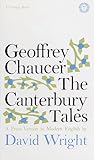 first one, and decided to go with a Modern English version for Chaucer. I chose David Wright's Modern English prose translation, written in 1964. I decided on a prose version because I really just wanted to know the stories, and if I'm reading a translation anyway, I might as well read it in prose form. As Wright points out in his introduction, it can be difficult to translate poetry while trying to maintain the poem, creating difficulties for the reader. One thing I found interesting was that for two of the tales, Wright simply gives the reader the gist of it, and does not bother including them in the book. He seems to feel that, even translated, these pieces are unnecessarily long-winded and unwieldy, and we would be better off without them. These are "The Tale of Melibeus" and "The Parson's Tale".
I was so surprised by the vulgarity, sex, and humor that were present in these tales. It was fascinating how the tales swung back and forth between morality stories about the saints and stories about wayward wives and their sexual exploits. I found some of the stories very very funny, which was another surprise. It's fantastic that even though this was written over 600 years ago, we still can find so many points of commonality. Of course, our views of women have changed (for the most part), and the overall culture's views towards God and the Church are different, but these details only make the tales more intriguing. I think it is truly incredible that we have this opportunity to read stories that give us a glimpse of what life was like centuries ago. And it is so much fun to read. Really, this is a very highly recommended translation for anyone who is considering reading The Canterbury Tal
 es.
es.
Reading classics is so much fun, I'm doing it for multiple challenges! This book fits right in with the Really Old Classics Challenge and the Centuries Challenge. It is also my "C" book for the A-Z Reading Challenge.


 Posts
Posts

