Saturday, January 10, 2009

Library Loot!!

This is a fun weekly event that was thought up by Eva at A Striped Armchair. I have never really been interested in these sorts of weekly blog events before, but this one is perfect for me. I get probably 80% of the books I read for my blog from the library, and I pick up several every week. I'm not sure what day of the week will be Library Loot day. But for this week's loot, it's today!
This week I got Europe Central by William T Vollmann and The News From Paraguay by Lily Tuck, both of which qualify for the Well-Seasoned Reader Challenge and at least one of my other challenges. I also picked up Maus by Art Spiegelman and Robot Dreams by Sarah Varon for the Graphic Novels Challenge. The other three books I picked up may qualify for one challenge or another, but I didn't pick them up specifically for that. They are Heir to Sevenwaters by Juliet Marillier (because I will read anything new by her), Firestar's Quest by Erin Hunter (is there something wrong with me that I love these warrior cats so much?), and Socially Responsible Investing by Amy Domini (I had this one checked out awhile ago, but had to return it without reading it - so we'll see if I get it read this time around).
Seven is a larger amount than is typical for me, I guess. I think I actually usually get three or four a week. Either way, this should be a fun way to keep track!

Wednesday, January 7, 2009

Year of Wonders by Geraldine Brooks

To begin this review, I have to say that I am a big Geraldine Brooks fan, this being the only novel by her that I had not previously read. Unfortunately, this is not her best book.
Year of Wonders takes place in the 1600's, in a tiny mining village in England. The narrator is Anna, a young woman who has lived through the year, and helped to bury more than half the people in this town. Her lodger was the first person to die of the Plague, which takes her children and many others as well, eventually. In an effort to confine the disease, the town decides to cut itself off, allowing no one in or out, and receiving help from the neighboring towns only when that help can be left at a distance. Their efforts keep the disease from spreading any further, yet perhaps causes more deaths in their own village.
The heroic efforts of this small village come at a great cost. This book is definitely more violent than I had expected. Some of it is simply the violence of the time: witch trials, punishments for theft. But some of it seems unnecessary, although I understand that Brooks was trying to convey the madness that some of the villagers struggled with in their grief. The book is wonderfully well researched, which makes for a story that feels true. It is a fascinating read for anyone interested in the Plague, or in this time period, but it it not easy to read about what these people went through. Life was hard enough in the Medieval Period without the Plague.
This is my first review for the Medieval Challenge. I am really looking forward to the other books I'm reading for this challenge. Hopefully I can get it done by February 8th! This book also qualifies for the A-Z Challenge. As I am doing a to z authors, this book will stand for my "B" author.

Tuesday, January 6, 2009

Reading Like A Writer by Francine Prose

I was honestly surprised by just how much I got out of reading this book. It's not that I expected it to be unhelpful, but the wealth of information, and the way Prose conveys it, adds up to a terrific book. In Reading Like A Writer, Prose walks us through classic works of fiction, dissecting passages and pointing out how it is that the masters became masters. In each of the chapters she tackles a different part of writing (sentences, chapters, descriptions, dialogue, etc) and shows through example how great authors used these same story features. With all of the excerpts and detailed information, you might expect the reading to be tedious and dull, or maybe at least pedantic, but it is nothing of the sort. This book was truly a joy to read, one that I would love to actually own a copy of, as it has made me a better reader.
The book's subtitle is "A guide for people who love books and for those who want to write them". I definitely fall into the first group, though not really in the second. While reading the book, it does seem like Prose is speaking to future writers more than she is to lovers of books, but the wisdom that she passes along is no less useful. I have already noticed how my reading has improved, just over the week or two that I was reading this book. I feel that I've been able to get more out of books like Life of Pi and Year of Wonders. Reading this book also helped me to better articulate what was truly missing from The Exchange. The main rule it seems that Prose sets for new writers is that there are no rules, and look to the masters as your teachers. For readers, however, I think that this book is even more invaluable. And on a final note, I thought I should mention that I have not read most of the works that Prose quotes as she makes her explanations, but the quotes that she chooses, and the way she explains them, makes it so that anyone can understand and grasp her meaning. I highly recommend this book.

Sunday, January 4, 2009

Life of Pi by Yann Martel

First book of the New Year! This is a wonderful book that I finished in three days. I was honestly not expecting it to affect me as much as it did, although when it was given to me, or course I knew that it had been very well received in general. I was a little bit put-off by the premise of it: sixteen-year-old Pi Patel is trapped in a lifeboat crossing the Pacific Ocean with a 450-pound Bengal tiger. But this book is about so much more than that.
The fact that the first third of the book has nothing to do with being stranded out in the middle of the Pacific Ocean with a Bengal tiger is something that I think needs to be mentioned. Everything I've read about this book gives you the idea that that is the only important part of the plot. But the whole first part of Life of Pi is about Pi's life and family before the accident that strands him on the lifeboat. Pi's full name is Piscine Molitor Patel, Piscine Molitor being the name of a pool in Paris. Pi's family has never been to Paris. The fact of Pi's full name is just one of the ways that Martel does an incredible job characterizing Pi and his family. Pi himself chooses his nickname, in full awareness of the fact that it is a Greek letter that is used in mathematics. With this nickname he takes control over his life by taking control of the use of his name. Pi's father runs the zoo in their formerly French town, Pondicherry, in India. It is the 1970's, and Pi's father is increasingly concerned with the way his country is going. So he decides to pack up and move his family to Canada. Along with his family, he has made arrangements for the sale of most of the animals in the zoo, who will be coming along on the trip with them, at least as they cross the ocean.
I really can't say enough about what a wonderful story this is. Martel is an amazing storyteller, one who can make the simplest details profound, and who can make you feel like you are a part of his story. When reading this book, it is important to pay attention to how he is telling the story, as well as what he is saying. The chapter breakdown alone is something that leads you to think more about what it means to tell a story. This truly is a beautiful book that I expect is only more enjoyable the more times you read it.
This is the fourth book I've read for the From the Stacks Challenge. I got it as a gift at least two Christmases ago. So far this is my favorite read from this challenge. I am also using it for the RYOB (read-your-own-books) challenge, which is obviously very similar. I need help when it comes to reading the books that are on my shelves, as opposed to library books, so these challenges are excellent for me.
This book also qualifies for two other challenges that I signed up for. One of those is the A-Z Challenge, where I signed up to read books by authors a to z. So this is my "M" book.
The final challenge that I read this book for is the only challenge that I picked books out for ahead of time. Generally I dislike making specific booklists for challenges, but in this case, I decided to do it. The challenge is the 999 Challenge, a Librarything group challenge. The idea is to pick nine categories, and then read nine books in each category. I picked prizewinners as my categories. So one category is the Man Booker Prize, which Life of Pi won in 2002.
Here's hoping that more of my books will fulfill so many challenges.

Friday, January 2, 2009

The Exchange by Inga C Ellzey

"The right murder. The wrong person. The perfect love story." So proclaims the cover of this novel, written by someone who mainly seems to have written it simply so that she can say she did. This book suffers so much from the fact the Ellzey does not seem to particularly care about producing something readable. Her author bio states that it was her dream to write a novel, and now she has. Congratulations to her for achieving her dream.
There are many reasons why this book was difficult to read: ridiculous expository dialogue, bad sex scenes, a predictable, yet not very believable plot. Jewelle is a complete work of fantasy. She is in the Witness Protection Program, which has taken her away from the oh-so-glamorous world of the medical billing industry. To try to recapture some of that excitement that her life has lost, she goes on a cruise. Immediately, every character that she meets becomes her best friend, if female, or new sexy love interest, if male. Within days she is closer to these people than she has ever been to anyone, and they all love each other dearly. So when Jewelle's identity is discovered, and she is once again in danger from the Mob, these friends will sacrifice everything to save her. I didn't even like Jewelle that much, but I suppose that wasn't the point.
It is clear that this book did not get any help from writing workshops or editors. And if it did, they were not doing a very good job. When something is described as being from a picture out of an "I-Maxx" movie, you know that both the author and the editor are not trying very hard.

Thursday, January 1, 2009

2009 Challenges

Hello, my name is Jeska, and I'm a challenge-oholic. Yes, it's true, I have signed up for entirely too many challenges this year. When I began signing up for them, I think I thought that I would have a lot of cross-over books. I still believe that many will be crossovers, but I may be a little bit overwhelmed. Oh well, it's an awesome way to encourage reading new books. And I have a new rule for myself. I will not be signing up for any challenges that have already started, which means I will not add any more that start Jan 1st! I also typically do not sign up for challenges that require me to do a blog post specifically about the challenge. (I was even removed from a couple when they added that rule! How rude and stifling! This blog is about books, and I am not interested in doing that many miscellaneous posts.)
I have already mentioned some of the challenges that will be appearing in my blog posts. Other challenges that you will likely be seeing soon are the new Martel-Harper Challenge and the Well-Seasoned Reader Challenge. There are many types of challenges on my list, some of which are to read from a specific genre, read a specific author, and many that are kookier and harder to describe. There are the read-a-new-author or read-a-new-book challenges, and the read from your tbr stack challenges. All of these will be helping me to push the limits of my reading and discover new books and authors, and maybe even genres. I will be tracking my progress on my sidebar for each challenge. Each challenge will also be linked on the sidebar, and in the posts about the books for that challenge, so if you would like to join, please do so! I'm really looking forward to all of the great books I will be reading this year!

Wednesday, December 31, 2008

Favorite Reads of 2008

For my final post of the year, I bring to you my favorite reads of 2008. Looking back, I found that I have listed 21 books as "recommended". So now the trick is to somehow narrow that list down to my top five. Here they are, in no particular order. (I'm terrible at choosing one over the other - picking five out of 21 was hard enough!)
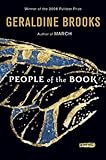
If I was required to pick an absolute favorite from the year, this one might be it. People of the Book by Geraldine Brooks became a new favorite of mine immediately, and made Brooks an author whose books I will now keep a special eye out for. Describing the plotline of the book really does not explain how beautifully the story is told. It is the story of a book, a manuscript that has been rediscovered, and is now being researched and restored. As the one in charge of restoring the book, Hanna, discovers more about its history, the reader gets a glimpse of that piece of the book's life. Like I said, that description does nothing to describe the depth of feeling that comes through in each of these stories. I love books, and book history, but I think that this book would appeal to anyone who loves to read well-researched historical fiction.
I Am the Messenger was the second book that I read by Marcus Zusak (the first being The Book Thief), and it placed him solidly on my list of favorite authors. The story follows Ed Kennedy, an underage cabdriver who doesn't have much of a plan for his life, a fact which seldom bothers him. Then he stops a bank robbery, and his life becomes a kind of mystery. He begins receiving playing cards, aces, which have cryptic instructions on them that he struggles to decipher and follow. His life changes dramatically as a result of these strange messages, in a way that is uplifting but not pedantic. Ed is a fantastic character, one who you love to root for, who is deep and complicated and not perfect, but who you would love to have as a friend. This book is often catalogued as a teen book, but it would be enjoyed by teens and adults of any age.
Another teen book, actually a series, that can easily be appreciated by adults (I've actually recommended it to several friends) is the Eugenides series by Megan Whalen Turner. This series consists of The Thief, The Queen of Attolia, and The King of Attolia. I wish I knew whether or not there were going to be more books in this series, because the character of Eugenides is terrific, and I can't wait to find out more about him. The best part about this series is how crafty and surprising Eugenides is. The second best part is the fact that none of the characters are formulaic - they are all surprising and individual, never doing what you would predict. This is an excellent series for middle schoolers on up to adults, and would be enjoyed even by those who don't tend to read fantasy.
For some reason, The Curious Incident of the Dog in the Night Time, by Mark Haddon, reminds me of I Am the Messenger. I think that part of it has to do with the way that they both hook you instantly. They are both quick reads, and once you begin them it is almost impossible to put them down. Nothing in the plot is similar to I Am the Messenger, however. The Curious Incident is about a 15-year-old autistic boy who sets out to discover the identity of the murderer of his neighbor's dog. It is told in first-person point of view, so we know every thought that goes through Christopher's head. The fact that he is a high-functioning autistic makes this a fascinating story to read. He is logical to the point where he can't understand metaphors or cliches, so he just responds as if he did not hear them. His interactions with others make this story humorous, but it is also dark in many ways. Enough babbling, I just loved this book.
My final recommendation of favorite reads of the year was Half of A Yellow Sun, by Chimamanda Ngozi Adichie. This was a heartbreaking book, about the seccession of Biafra from Nigeria in the late 1960's. Biafra's symbol is the rising sun, a theme that is carried throughout the book. The war ends badly for the Biafrans, as the validity of the country was never recognized by most of the world. The story is told from the point of view of three different people, whose lives interact in various different ways. It is beautifully told, and even though the reader knows the outcome of the war, the book itself is filled with hope. It is a long book, and a difficult read, but well worth the time.
And there you have it. My five top favorites of 2008. If you are interested in seeing what the other 16 titles were that I labeled as recommended, just click on the link in this post.
Happy New Year's Eve!

Tuesday, December 30, 2008

Books I read this year, but just couldn't bring myself to finish

Because today is the second to last day of 2008, I thought I would do my first year end wrap-up post. In this post I would like to talk about the books that I began but was simply unable to finish. There are a variety of reasons why this is the case - it really depends on the book.
The first book on this list is God is Not Great by Christopher Hitchens. I have to begin by saying that I do believe in God, but I went into this book with an open mind, because I do agree with some of Hitchens's main points (religion can be bad, after all). And I actually got through more than 70% of the book. But I just had to stop. Hitchens just kept restating his point over and over, and many of his examples did not even seem to apply to the issue. He was just mad and wanted to rant and rave a little bit. I had had enough.
This next book I actually almost finished. But then I couldn't keep reading. I honestly am not sure exactly what it was, but even after reading 80% of Call Me by Your Name, by Andre Aciman, I just did not care, and did not even want to know what happened to the characters. This happens to me sometimes - I put in a great deal of effort to read a book, hoping it will make it worth my while, but I just give up if it doesn't seem to be going that way. Sometimes I'll stick it out, and sometimes not, and this just happened to be one of those that I did not.
Mothers and Sons, by Colm Toibin, is another book that I probably could have stuck with, but I could not really find a reason to. I think part of it was my frame of mind at the time I was reading it. The stories tended to depress me, and I could not seem to find any redemption from any of them. I probably only read two or three, so I may have missed a very good story or two, but the initial stories did not keep me reading long enough to find out.
Rose of No Man's Land, by Michelle Tea, was one of those books where I was just looking for a chance to put down. I had no good reason for why I didn't like it, I simply was not enjoying the book, but I continued to read it. Right up until Rose did something completely disgusting that, while it was definitely an excellent way to characterize her, fully put me off of this book for good. It may seem petty, but I will quit reading a book if the characters continually make decisions that I have a difficult time reading about. This was one of those books.
A Walk Through Time, by Stanley Liebes, seemed like an interesting book, but I found after reading about a quarter of it that I just didn't feel like slogging through to the end. It was written based on a display at a museum, one that showed the timeline of the universe and Earth's history over a mile-long walk. It is a very intriguing idea, and I'm sure it made for a fascinating live display, but reading a book based off of it was slow and disjointed.
Poor Carlo Chuchio, I just could not make myself care about his story. In The Golden Dream of Carlo Chuchio, by Lloyd Alexander, Carlo sets out on a grand adventure, meets all sorts of interesting characters, and, presumably, finds what he seeks and learns about life in the process. This is the only children's book on this list, because typically I will give books written for kids a little bit more leeway when it comes to keeping me interested. But in this case, I gave this book a good chance, and just could not complete it.
The final book on this list, Wizard of the Crow by Ngugi Wa Thiong'o, is interesting because it is the only book on the list that I am not sure why I stopped reading. I think it was simply moving too slowly for me, and it was such a large book that I feared I would never finish it. But I think that I will be giving it another try. This one has officially been added to my to-be-read list, and will be given another chance.
I would be interested to know if anyone else has read any of these books, or has any opinions on them. Did you love or hate any of the books listed here? You may be able to convince me to give others a second chance as well.
Monday, December 29, 2008

Warriors series by Erin Hunter

Well, I didn't get much reading done over my holiday trip, but I did manage to finish one book. And that book wrapped up a series. I review the Warrior books as a series because reviewing them individually gets seriously repetitive and does not do them justice. This is actually the second of these series that I've read - I read The New Prophecy series before reading this one (my review is here), but reading the series out of order is not really that big of a deal.
I have to say that if these books had been out when I was in elementary school, they would have been my favorites. Even with the level of cat-against-cat violence, I think I still would have loved the idea of these wild forest cats living according to a warrior code. The first book in this series, Into the Wild, introduces us to Rusty, a house cat who feels the call of the forest. He meets some of the warrior cats of ThunderClan, and is accepted among them as an apprentice warrior, and renamed Firepaw. He must deal with prejudice against "kittypets" such as him, and prove that he can be a loyal and valuable member to ThunderClan.
The main plotline of the series as a whole is Firepaw's rivalry with Tigerclaw. In the first book Firepaw discovers Tigerclaw's treachery - he would do anything to gain power, even kill members of his own clan. Later, as Firepaw becomes a full warrior and is renamed Fireheart, he must continue this battle. It isn't until the third book, Forest of Secrets, that Fireheart is able to prove Tigerclaw's treachery and get him exiled from the clan forever. But that is not the end of his troubles with Tigerclaw. Tigerclaw continues to plague ThunderClan, and carries a personal vendetta against Fireheart. In addition to this main plotline, the clan must hold its own against the three other clans of the forest, as well as dealing with natural occurances like drought, storms, and fire.
I have to say that I do love these books, although they are a bit on the overdramatic side at times. And the violence is not something that can be ignored. These cats fight and kill each other, and are also killed by predators like birds of prey and feral dogs. They live a tough life. But for a kid that can handle that level of violence, these books are great. Older elementary school kids or younger middle schoolers are usually who I recommend this book to. There are powerful themes of acceptance and loyalty, trust, friendship, and family. And now I get to move on to another book in this world! The books in this series are: Into the Wild, Fire and Ice, Forest of Secrets, Rising Storm, A Dangerous Path, and The Darkest Hour.

Saturday, December 20, 2008

Challenges for the new year

I am well aware of the fact that I have severely over-extended myself in terms of the challenges that I signed up for for 2009. You may have noticed that my list just keeps getting longer and longer, and I'm sure you are wondering if I've lost my mind. The answer: probably. I will be discussing next year's challenges in more depth at the end of this month, or the beginning of the next. For now, I wanted to bring up two that I have signed up for that are going on now, but that will finish before the end of next year. (I have already mentioned the From the Stacks Challenge, which will be wrapping up at the end of January.)
The first of the two that I have not yet read anything for (shame on me!) is the Medieval Challenge. This one goes until the 8th of February, 2009. This means that I better get a move on, since I signed up to read six titles. So far on my list are one non-fiction about the time period, one book written during the time period, and a modern book about the time period. (I plan on doing two each.) The titles are: Medieval Britain: the age of chivalry by Lloyd and Jennifer Laing; The Canterbury Tales by Chaucer; and Year of Wonders by Geraldine Brooks.
For the second challenge, the Really Old Classics Challenge, I somehow went just a little bit insane and decided that I would read 29 books on this topic. I think I wasn't thinking very clearly that day, but now I feel like I can't go back on that number. Silly, right? Anyways, the challenge runs until the end of July 2009, so I have more time. The idea for this challenge is to read the classics written before the 1600's. I have already read a few in past years, so my goal is to read titles that are new to me. If I run out, rereading these classics is never a bad thing.

Oh, and on a completely separate note - I will be out of town for the next week or so. I may manage to get a review up, if I finish a book and have the time (not likely), but don't hold your breath.
Happy Holidays everyone!!